
Customer Decisioning Blueprint [Part 3/7]
Customer Decisioning Blueprint: How to convert Data, AI and Context into Real-Time Customer Action

A Quick Recap
In the first and second parts of this Customer Decisioning Blueprint series, we examined the core paradox of modern marketing: despite major investments in data, AI, and increasingly sophisticated channels, customer experiences remain fragmented because the decisioning layer - the capability that turns information into action, has not kept pace. Part 1 traced the historical forces behind this gap, showing how marketing complexity outgrew organisational alignment. Part 2 introduced the six foundational principles for treating decisioning as an enterprise discipline, forming the philosophical basis for decisioning maturity, and presented the “T-Circle” Level 0 of the Blueprint.
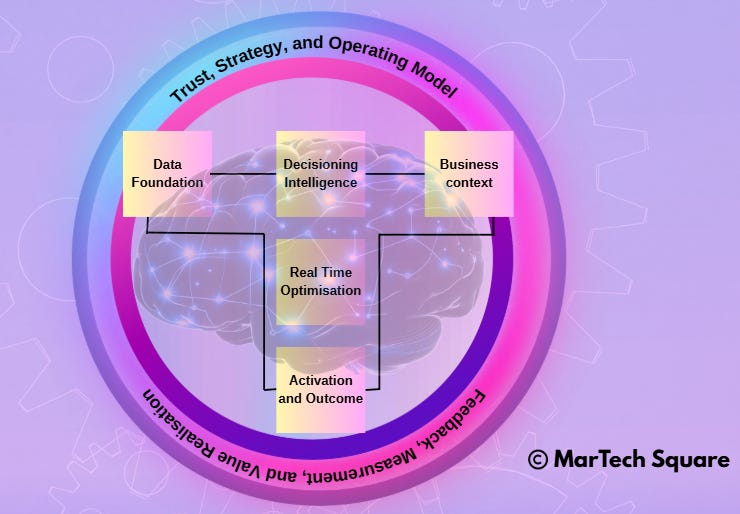
T-Circle Customer Decisioning Blueprint
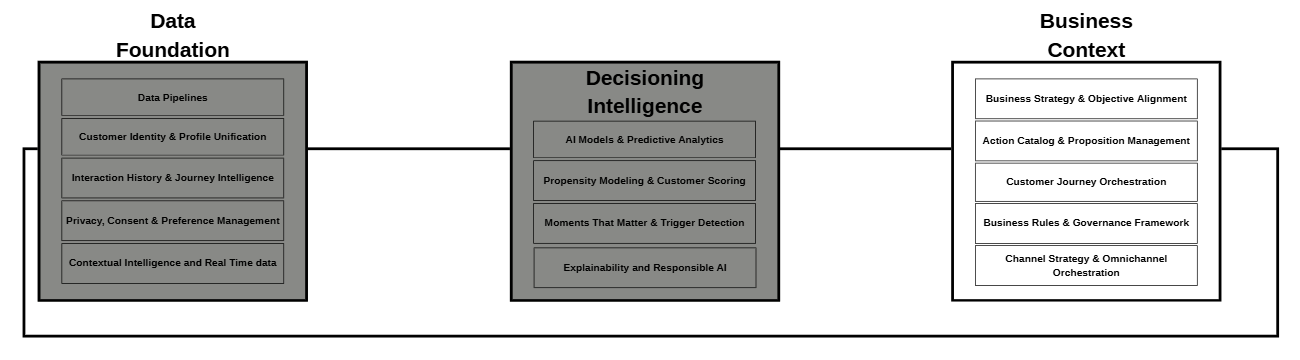
The T-Circle Customer Decisioning Blueprint is built around a T-shaped architectural core representing the minimum viable structure for enterprise-grade customer decisioning. The horizontal bar reflects the foundational breadth across the organisation -Data Foundation, Decisioning Intelligence, and Business Context, ensuring decisioning is grounded in quality data, powered by strong analytical logic, and aligned with strategy, propositions, regulatory expectations, and channel realities.
The vertical spine represents the Real-Time Optimisation Core, embodying the depth required to translate signals into action through arbitration logic, adaptive learning, contextual triggers, and optimisation capabilities. At the base sits Activation & Outcome, the execution layer where decisions are deployed across channels and their impact measured, closed-looped, and fed back into the system.
Encircling the T-shape is a circular meta-layer that provides strategic coherence and long-term resilience. Anchored in trust, governance, operating model, measurement, and value realisation, it ensures decisioning operates ethically, transparently, and accountably. The circular form represents continuity - a cycle of learning, refinement, and improvement that enables the capability to evolve with changing customer needs, technology, and business models.
The Horizontal Bar - The Enterprise Decisioning Base
In Part 3, we turn our focus to the Horizontal Bar - the Enterprise Decisioning Base. Spanning Data Foundation, Decisioning Intelligence, and Business Context, this layer forms the connective tissue that enables decisions to be made once, understood universally, and executed consistently across the enterprise. It is the infrastructure of alignment and, often, the most overlooked element of customer decisioning.
High-performing organisations - Expedia, Morgan Stanley, CBA, Netflix—have learned that the real advantage lies not in smarter models or bigger data platforms, but in building a unified decisioning system that connects identity to judgement, judgement to strategy, and strategy to activation. The Horizontal Bar is what makes that unity possible.
On the left, the Data Foundation provides the bedrock of decisioning: data pipelines, identity resolution, journey intelligence, privacy and preference management, and the real-time signals that give systems situational awareness. It ensures decisioning is grounded in accurate, timely, and ethically governed information.
At the centre sits Decisioning Intelligence, the analytical core that transforms signals into insight. This includes predictive models, propensity scoring, moment detection, and the responsible AI frameworks required for transparency and trust. Here, data becomes probability, relevance, and recommended action.
On the right, the Business Context domain anchors decisioning to organisational reality - strategy, proposition management, journey design, business rules, and channel orchestration, so that decisions are not only technically sound but also commercially viable, operationally feasible, and compliant with regulatory expectations.
Together, these domains form the Horizontal Bar of the T-shape, an end-to-end foundation for scalable, coordinated, intelligence-led customer engagement. When wrapped by the circular meta-layer of principles and governance, the T-Circle Decisioning Framework becomes a complete architecture for translating data, AI, and context into real-time customer action.
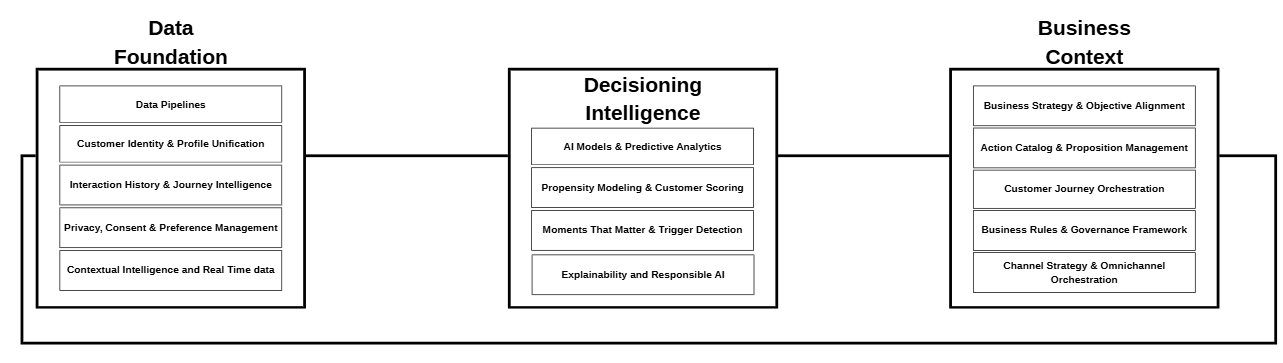
Decisioning as a Single Operating System
The Horizontal Bar is the cross-cutting layer that binds Data Foundation, Decisioning Intelligence, and Business Context into a single operating model. Without it, decisioning devolves into siloed activities rather than a unified capability - data teams optimise pipelines, analytics teams optimise models, and channel teams optimise delivery, but the organisation never optimises decisions.
Research confirms that the barriers to AI and personalisation success are structural, not technical.
A comprehensive MIT Sloan Management Review study with BCG found that while 85% of executives believe AI will offer a competitive advantage, only 10% achieve significant financial benefits, largely due to a lack of organisational learning and process integration rather than model capabilities.
Similarly, Gartner has predicted that 80% of personalisation efforts will be abandoned not because of technical limitations, but due to a lack of ROI and failures in data management governance. (I don’t think that it actually happened but that’s for another day). This alignment gap is costly.
McKinsey & Company’s benchmarks reveal that ‘personalisation leaders’—those who effectively unify data and decisioning across teams—generate 40% higher revenue from those activities and achieve 3–4× higher returns on their AI investments compared to their peers.
Customer Decisioning is not a technical capability - it is an organisational one.
Data Foundation: The Bedrock of Decisioning
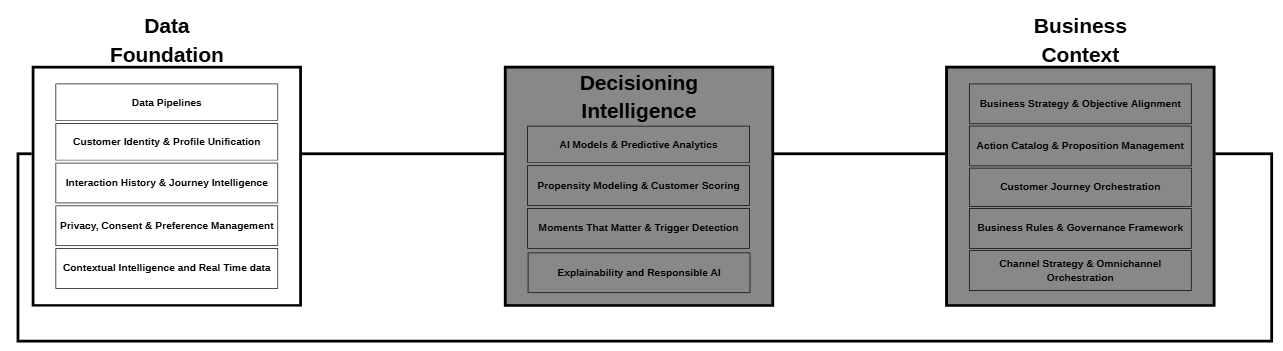
Among the three pillars, the Data Foundation is often the most mature yet paradoxically the least leveraged for decisioning. Many organisations have invested heavily in cloud platforms, data lakes, CDPs, and identity solutions, but without the Horizontal Bar these assets remain operational rather than strategic. They support reporting or targeting, but rarely power consistent, real-time enterprise decisioning.
The Data Foundation begins with data pipelines that ensure identity, behavioural signals, transactions, and contextual events flow predictably into the decisioning ecosystem. These pipelines form the organisation’s circulatory system. What distinguishes decisioning-ready pipelines is their focus on freshness, completeness, and explainability. In advanced organisations, pipelines are not just technical transports - they are governed assets enabling accountable decisions.
Customer identity and profile unification is equally critical. Without identity resolution across channels and business units, even sophisticated AI models generate inconsistent or incomplete outputs. McKinsey benchmarking shows that companies successfully leveraging unified first-party identity data achieve a 5–15% revenue uplift in their most impacted channels, illustrating that personalisation quality is constrained by identity quality.
Interaction history and journey intelligence are also essential, enabling systems to interpret behaviour as sequences rather than isolated events. Decisioning thrives on recency, frequency, and pattern recognition. Yet Salesforce research shows that while 79% of customers expect a unified experience, more than half feel they interact with multiple uncoordinated teams - an organisational cost of fragmented context.
Modern Data Foundations must also embed privacy, consent, and preference management. These are not legal add-ons but ethical boundaries for decisioning. Cisco’s 2023 Consumer Privacy Benchmark Study found that 76% of consumers would not buy from a company they do not trust with their data. When privacy expectations drive trust and engagement, ethical data handling becomes a functional prerequisite.
Finally, contextual intelligence and real-time data enable the system to respond to situational conditions. Real-time context transforms decisioning from static recommendation to dynamic, behaviour-responsive optimisation. Research shows that recommender systems powered by real-time, multi-behaviour streaming data significantly outperform static models across accuracy, recall, conversion, and satisfaction.
Together, these components form the substrate on which enterprise decisioning intelligence is built.
Decisioning Intelligence: The Analytical Core
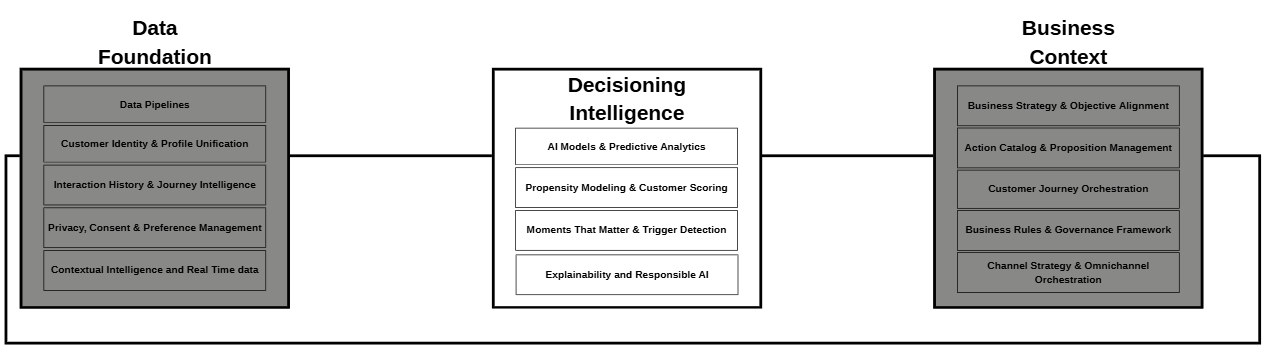
Decisioning Intelligence is the interpretive core that transforms data into actionable outputs. It is the analytical and algorithmic machinery that determines what should happen next for each customer in each moment.
At its centre are AI models and predictive analytics that estimate propensities, risks, needs, and likelihood of response. These models - from next-best-offer to churn and health engagement predictions, form the mathematical backbone of enterprise decisioning. Yet predictive accuracy alone is insufficient; only 10% of companies see meaningful financial gains from AI because operational integration and organisational alignment remain the biggest barriers, according to MIT study.
Propensity modelling and customer scoring complement this by quantifying outcome probabilities and helping the system prioritise interventions. These scores are essential for resource allocation, especially in sectors like healthcare and financial services where capacity and eligibility constraints shape priorities.
Decisioning Intelligence also includes moment and trigger detection, enabling systems to recognise pivotal behaviours or life events—signals far more predictive than static attributes. Expedia’s AdaptEx , for example, identified over 60 behavioural triggers across its brands and achieved an 18–22% conversion uplift, driven not by more data but by identifying inflection points.
Advanced ecosystems also incorporate explainability and responsible AI to ensure decisions are auditable, fair, and compliant -critical for regulated sectors. A 2025 meta-analysis, Is Trust Correlated With Explainability in AI?, found a significant positive correlation between explainability and user trust across 90 studies.
Decisioning Intelligence is the enterprise’s intellectual engine - continuously interpreting customer state, recalibrating priorities, and aligning decisions with organisational objectives.
Business Context: The Strategic Anchor
The third pillar, Business Context, ensures decisions reflect the organisation’s strategic intent, commercial priorities, customer promises, and regulatory obligations. It anchors the decisioning engine in purpose, preventing AI from optimising for behaviour that is statistically likely but strategically misaligned.
This begins with aligning decision logic to enterprise objectives. Without this, engines may optimise for short-term clicks rather than long-term outcomes. Google paper “Focusing on the Long-term: It’s Good for Users and Business, shows that systems tuned for near-term revenue - such as increasing ad load, ultimately damage long-term revenue by degrading user experience. Their experiments demonstrated that reducing mobile ad load hurt short-term revenue but improved satisfaction and did not harm long-term revenue, proving the need for long-horizon optimisation.
A mature ecosystem also relies on a well-governed action catalogue and proposition management capability - the library of interventions from offers and service pathways to health nudges and educational content. Catalogue quality and governance directly shape customer experience richness. According to this McKinsey Study, companies mastering personalisation through strong catalogues generate 40% more revenue from these activities.
Equally critical is customer journey orchestration, which ensures decisions connect across the lifecycle rather than appearing as one-off interactions. This shifts decisioning from a recommendation engine to an experience engine. CBA demonstrated this through its “Benefits Finder” service, which integrated decisioning signals and helped return $1 billion in unclaimed government benefits—possible only because decisions were contextualised across the journey.
The Business Context layer also contains the business rules and governance framework - eligibility, risk posture, prioritisation, exclusions, regulatory constraints, and ethics. Rules remain indispensable in the AI era; Gartner predicts over 40% of agentic AI projects may be cancelled by 2027 due to inadequate risk controls, underscoring the stabilising role of governance.
Finally, channel strategy and omnichannel orchestration ensure decisions are expressed consistently across touchpoints. In advanced organisations, channels do not determine logic—they merely execute it. With more than70% of shoppers interacting across multiple channels, companies with strong omnichannel engagement achieve retention rates up to 89%.
Business Context is therefore the strategic anchor of the decisioning system - ensuring intelligence serves strategy, not the reverse.
Bringing the Horizontal Bar Together
When the Horizontal Bar is fully established, the three pillars no longer operate in isolation. Data Foundation becomes a strategic asset powering enterprise intelligence. Decisioning Intelligence becomes the interpretive brain of customer engagement. Business Context becomes the organisational conscience that keeps decisions aligned to purpose.
Enterprises that achieve this alignment excel not because they have better technology, but because they operate as one brain rather than disconnected organs. They make decisions once, govern them centrally, activate them consistently, and improve them continuously.
This coherence is the core promise of the Customer Decisioning Blueprint - and the Horizontal Bar is what makes that promise achievable.
Next in the Series (Part 4/7)
In Part 4 of this series, we turn to the next dimension of the Blueprint: the vertical bar - The Decisioning Value Chain. I look forward to continuing the discussion next week.
Requests
I’d love your feedback - it only takes a minute! Tell me what you think and what you’d like to read next. This is the Survey Link.
If you are a Customer Decisioning leader or practitioner whether on the brand side or vendor side, I’d love to have a chat with you about an upcoming project. Please feel free to drop me an email at pawan[@]martechsquare.com