
Customer Decisioning Blueprint [Part 1/7]
Customer Decisioning Blueprint: How to convert Data, AI and Context into Real-Time Customer Action

Satya Upadhyaya and I presented closing keynote at MarTech Retreat by Ashton Media on the topic of Customer Decisioning - The Brain of Modern MarTech. This is also the first time that we presented Customer Decisioning Blueprint - something is being worked upon from last few months and is now in a good state to present and discuss with this audience group.
Marketing Technology Retreat 2026
Before we get into the Customer Decisioning Blueprint, I have to acknowledge the MarTech Retreat. A huge thank you to the organisers for crafting such a thoughtful, immersive, and inspiring experience for MarTech leaders across the industry.
Every part of the retreat felt intentionally crafted - from the insightful sessions and hands-on workshops to the curated experiences like wine tasting and golf. The setting at RACV Cape Schanck elevated the entire event; it’s a truly beautiful property with sweeping water views and an exceptional golf course.
There were so many great sessions that it’s impossible to name them all. But I do want to highlight the fantastic opening keynote on Key MarTech trends of 2026 by Jonathan Goh, Head of MarTech and Orchestration at Medibank. And yes, I might be biased - but Anita Hajdinjak and Khachig Kabakjian were truly exceptional with their Decisioning and Personalisation presentation and the Bupa story that followed.
Satya and I also had the privilege of presenting Customer Decisioning – The Brain of Modern MarTech. The response and the conversations that followed were energising and deeply encouraging, reaffirming our passion for this discipline. I’ve long believed that we’re entering a defining decade for Customer Decisioning - not just as a technology, but as the central operating system of modern marketing.

A big thank you to Ashton Media, the speakers, and the incredible practitioners who made this retreat such an enjoyable and meaningful experience. It genuinely felt like a community moment.
Golden Age of Modern Marketing
We truly are standing at the dawn of a Golden Age of Marketing.
With unprecedented volumes of data, increasingly powerful AI capabilities, advanced technology platforms, and ever-expanding channels, marketers have more opportunity than ever before. For example, studies show that the AI in marketing market size is expected to reach a value of $217.33 billion by 2034. Meanwhile, new channels continue to emerge and evolve influencer-driven commerce is expected to reach over $32.5 billion in 2025, and about 66 % of marketers say that AI has improved their influencer-campaign performance. On the data front, 84 % of marketers report that AI and automation are “very effective” at aligning web content with search intent, and 70 % say real-time analytics are now crucial to their strategies. MarTech leaders have access to 15,000+ Marketing tools at their disposal.
All of this means that the tools, the reach, the intelligence and the orchestration possibilities have never been richer. The question today is not whether we can market in these conditions-but how wisely we choose to leverage this cornucopia of marketing potential.
However, we are less effective than ever
Despite this unprecedented proliferation of data, technology, and AI-driven capability, modern marketing performance is characterised by a series of striking contradictions. On the surface, our systems are more sophisticated than ever powered by advanced analytics, automation, and intelligent orchestration. Yet the results often fail to reflect this sophistication. We have more channels, more datasets, more models, and more touchpoints, yet the customer experience itself remains largely undifferentiated and, in many cases, disappointingly average.
This paradox is not anecdotal; it is consistently validated by industry research and performance data. Consider the findings from 2025:
MIT - 95% of enterprise GenAI pilots fail to deliver measurable business impact or ROI
HBR - Despite 25% of marketing budgets spent on Martech, 49% of marketers report their results do not meet expectations, & 44% of purchased MarTech tools go unused.
Supermetrics - Marketers handling 230% more data than in 2020, but 56% don’t have enough time to analyse it.
Shopify - While 92% of brands claim to offer personalization, only 19% of US consumers rate these experiences as “good”—and 0% rate them as “excellent”.
Marketing has become significantly more complex, but not proportionally smarter. Organisations today generate an enormous volume of marketing outputs - emails, SMS communications, push notifications, audience segments, journeys, dashboards, and automated triggers. However, the cumulative impact of these outputs often remains modest, inconsistent, or difficult to attribute to measurable business outcomes.
This disconnect reflects a deeper structural issue. In the pursuit of scale, automation, and channel expansion, many organisations have lost sight of the customer - around whom everything is centred around. We have forgotten the basic science to guide customer interaction. Amid the noise of metrics, tooling, and operational throughput, we have drifted away from the most essential question in modern marketing:
“What truly matters for this individual customer, in this specific moment?”
This question is not trivial-it is the intellectual centre of personalised engagement. And at its core lies the discipline of Customer Decisioning: the capability that transforms raw data, customer context, and business strategy into precise, meaningful, real-time actions. Without this capability, even the most sophisticated MarTech stack struggles to deliver relevance, consistency, or value.
The Missing Middle Layer: Decisioning
To fully appreciate the challenges facing modern marketing, it is useful to revisit the foundational Customer Management Architecture proposed by David Raab. This framework delineates the marketing ecosystem into three interdependent system layers.
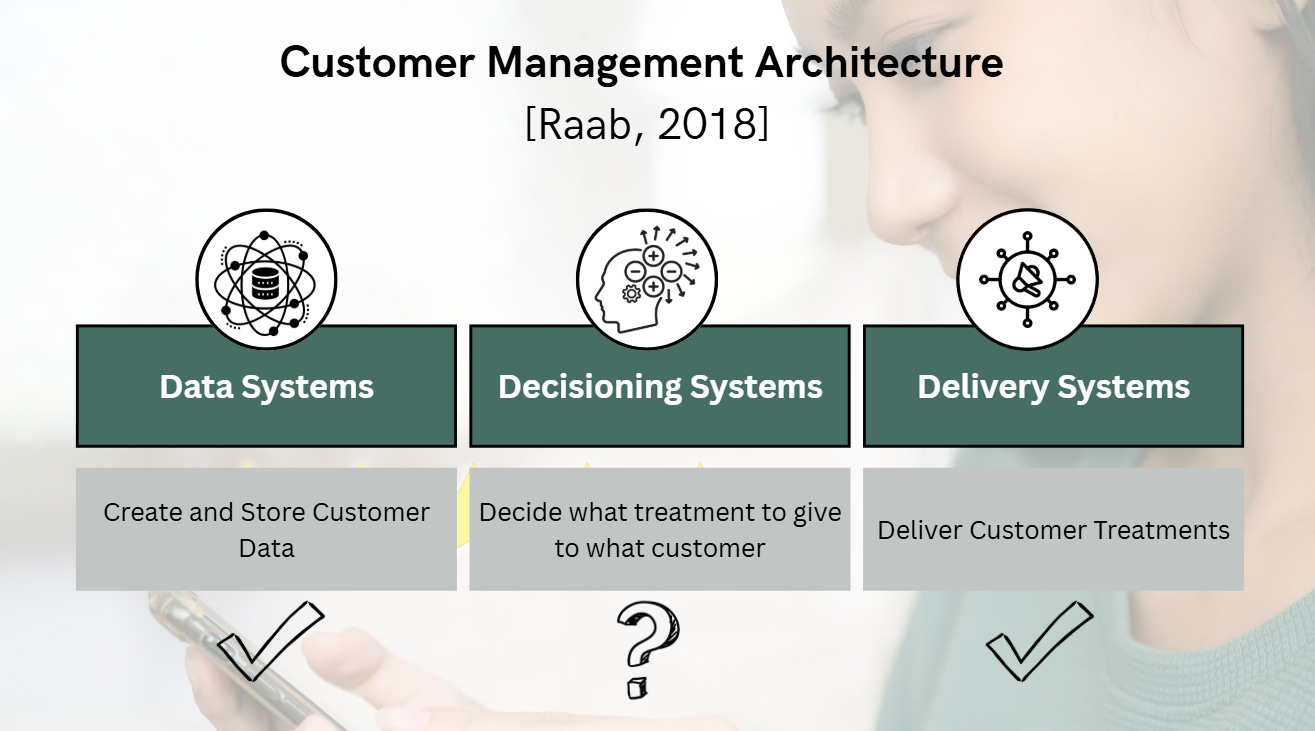
We argue that over the past decade, the industry has invested heavily, both financially and strategically, in the first and third layers of this architecture.
Exceptional Progress in Data Systems: Data capabilities have advanced at an extraordinary pace. CDPs have become mainstream, identity resolution has matured considerably, and privacy-first frameworks and data clean rooms have redefined how organisations manage and activate customer information. The foundational data infrastructure of most organisations is substantially stronger than it was even five years ago.
Significant Development in Delivery Systems: Similarly, delivery technologies have evolved rapidly. Nearly every platform today positions itself as an orchestrator of campaigns, journeys, or moments. Marketers now have access to sophisticated omnichannel automation engines, mobile personalisation suites, in-app experience layers, SMS orchestration platforms, and large-scale email systems - often referred to as “factories” due to their throughput.
The Neglected Layer: Decisioning Systems
In stark contrast, the Decisioning layer - the system that determines the “next best action” for each individual customer, has lagged behind in adoption and strategic attention. Although decisioning has long been established in domains such as credit risk and lending, it has not received comparable investment in mainstream marketing functions. Instead, it has often been treated as a specialised or peripheral capability rather than the core intelligence of the MarTech ecosystem.
This misalignment is evident in the findings of Scott Brinker’s 2025 State of MarTech report, where decisioning did not emerge as the central organising construct of marketing technology stacks. Instead, practitioners continued to orient around platforms such as CDPs, MAPs, analytics suites, and content systems, overlooking the essential role that intelligence must play in connecting data to meaningful action.
The implications of this gap are profound:
Data without decisioning becomes undifferentiated noise.
Delivery without decisioning devolves into scale-driven spam.
AI without decisioning introduces instability - if not outright chaos.
In other words, modern marketing has excelled at collecting data and executing communications but has not sufficiently invested in the intelligence required to determine what to deliver, when, and why. This is the structural deficit the industry has yet to resolve.
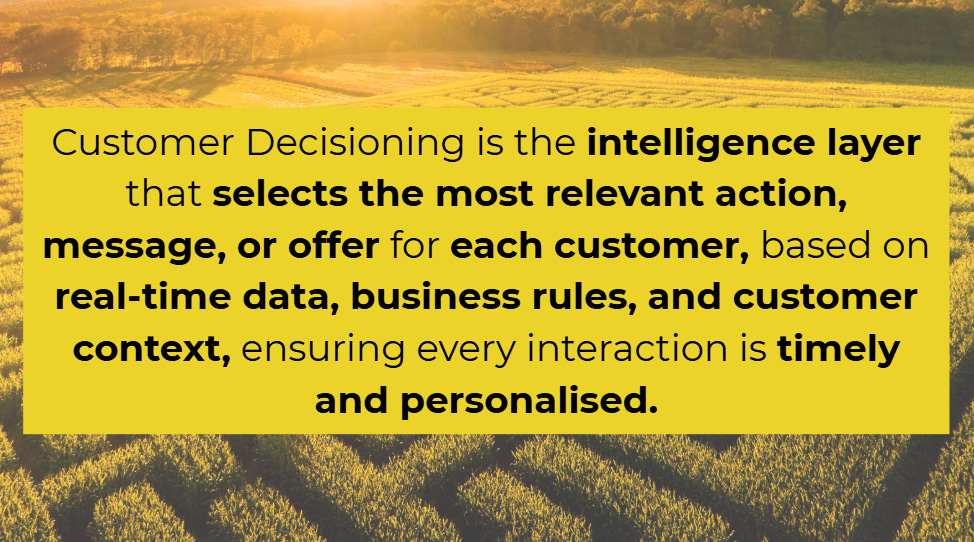
Customer Decisioning: Definition
To level-set, here’s the definition we use. I don’t believe that there is any contention to this.
The ‘AI’ Elephant in the Room
There is a looming question
Can We Simply Deploy AI and Expect It to Make All the Decisions?
A recurring, if often unspoken, question in contemporary marketing practice is whether advances in large language models (LLMs), autonomous agents, and generative AI now enable organisations to outsource the majority of decisioning to artificial intelligence. The narrative sounds appealing: if AI can generate content, orchestrate interactions, and infer customer intent, then surely it can also determine the “next best action” without human intervention.
However, the reality is far more nuanced. Our position is clear: Customer Decisioning extends well beyond the capabilities of current AI systems. At this stage of technological maturity, AI can augment decisioning but cannot replace the structured governance, contextual understanding, and strategic judgment required for enterprise-grade customer decisions.

While lighthearted, above mushroom meme has some truth: generative AI is fast, confident, and often compelling but still demonstrably fallible. In many cases, each request to an AI system can yield materially different outputs, creating unpredictability that many organisations cannot risk in regulated or high-stakes environments.
Beyond accuracy issues, there is a more subtle challenge: confirmation bias in generative models. These systems are inherently predisposed to align with user prompts, even when the prompts are poorly framed or misinformed. This creates a paradox for marketers. Over the past two decades, the industry has championed the shift from intuition-led decisions to evidence-based, data-driven marketing. Yet generative AI can inadvertently reverse this progress by validating subjective opinions under the guise of intelligence.
Consider a hypothetical, but highly plausible scenario: an enthusiastic marketing lead develops an idea with limited empirical grounding. By prompting an AI system for support, they may quickly receive a persuasive, well-articulated response “confirming” their idea. The result is an illusion of validity, not because the idea is sound, but because generative AI is optimised to be agreeable.
This dynamic underscores why AI cannot be the sole decision-maker in customer engagement. Without the guardrails of a robust decisioning framework - governance, rules, constraints, monitoring, eligibility logic, and human oversight, AI risks amplifying errors, biases, and subjective assumptions. Customer Decisioning, therefore, must be understood not as an “AI problem,” but as a structured discipline in which AI plays one role among many.
Decisioning as an Iceberg
Customer Decisioning can be effectively understood through the iceberg metaphor: a small portion is visible above the surface, while the critical infrastructure lies beneath.
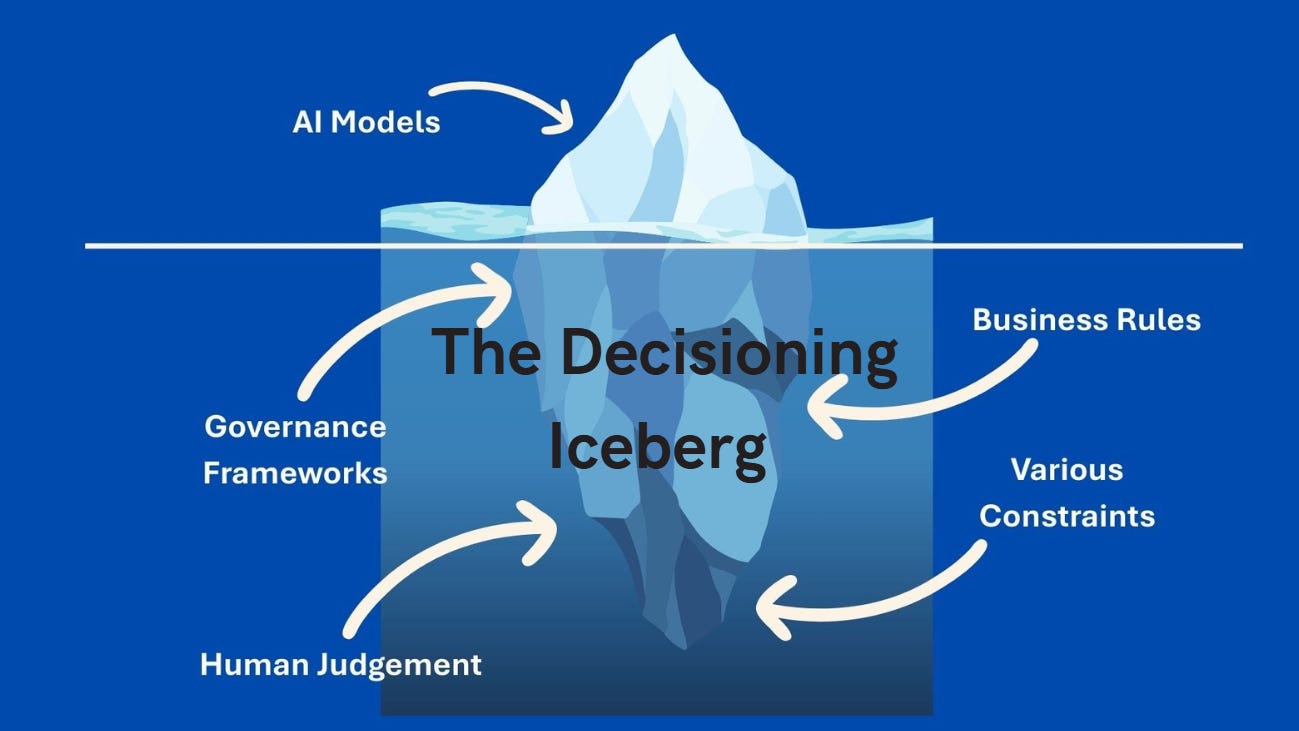
Above the Waterline: The Visible AI Layer
Most discussions focus on the visible aspects of decisioning - adaptive models, reinforcement learning, bandits, and generative AI. These elements appear prominently in vendor demos, AI roadmaps, conference talks, and strategic documents. They are compelling and easy to promote, but they represent only a fraction of what true decisioning entails.
Below the Waterline: The Hidden Foundation
The real substance of decisioning exists in the extensive foundation that supports these models:
governance and business rules
regulatory and ethical safeguards
versioning, auditability, and monitoring
override mechanisms and guardrails
customer eligibility logic
lifecycle and prioritisation frameworks
human judgment and domain expertise
These components cannot be automated or inferred by AI. They ensure decisions are accurate, relevant, and responsible - preventing ineffective or unethical outcomes.
The Risk of Focusing Only on the Visible
Overemphasis on the visible layer - Technology Platforms, AI models and product features, combined with underinvestment in governance and structure creates fragile systems that fail under real-world complexity. AI-driven innovation is valuable, but it must be grounded in a strong decisioning foundation.
Ultimately, if the base of the iceberg is weak, the visible tip cannot stand. Effective Customer Decisioning requires not only advanced AI but the organisational infrastructure that guides, constrains, and governs it.
The Solution - Customer Decisioning Blueprint
If contemporary marketing has reached a point of overwhelming complexity, if artificial intelligence cannot independently resolve the challenges of personalisation and orchestration, and if Decisioning remains the structural gap in most MarTech ecosystems, then the path forward becomes clear. Organisations require a Customer Decisioning Blueprint - a structured, layered framework that defines how intelligence should be organised, governed, and operationalised across the enterprise.
Such a blueprint provides the mechanisms to balance business rules, AI-driven models, and contextual understanding; to embed governance and risk management; to support decision-making at scale; to enable consistent execution across teams; and to eliminate fragmented or siloed approaches to customer engagement. Most importantly, it ensures that every customer interaction is purposeful, contextually relevant, and grounded in real-time data.
Next in the Series (Part 2/7)
In the next part, we will explore the foundational principles and the Level 0 framework of the Customer Decisioning Blueprint. I look forward to continuing the discussion next week.
Requests
I’d love your feedback - it only takes a minute! Tell me what you think and what you’d like to read next. This is the Survey Link.
If you are a Customer Decisioning leader or practitioner whether on the brand side or vendor side, I’d love to have a chat with you about an upcoming project. Please feel free to drop me an email at pawan[@]martechsquare.com
Thanks Pawan for this detailed series on Customer Decisioning Blueprint.
I am studying this article lately, but I feel it's good time to study all the articles in this series at a time.
Thanks again for your contributions to the Decisioning community.
Thanks for writing. Customer Decisioning Blueprint is truly pivotal.