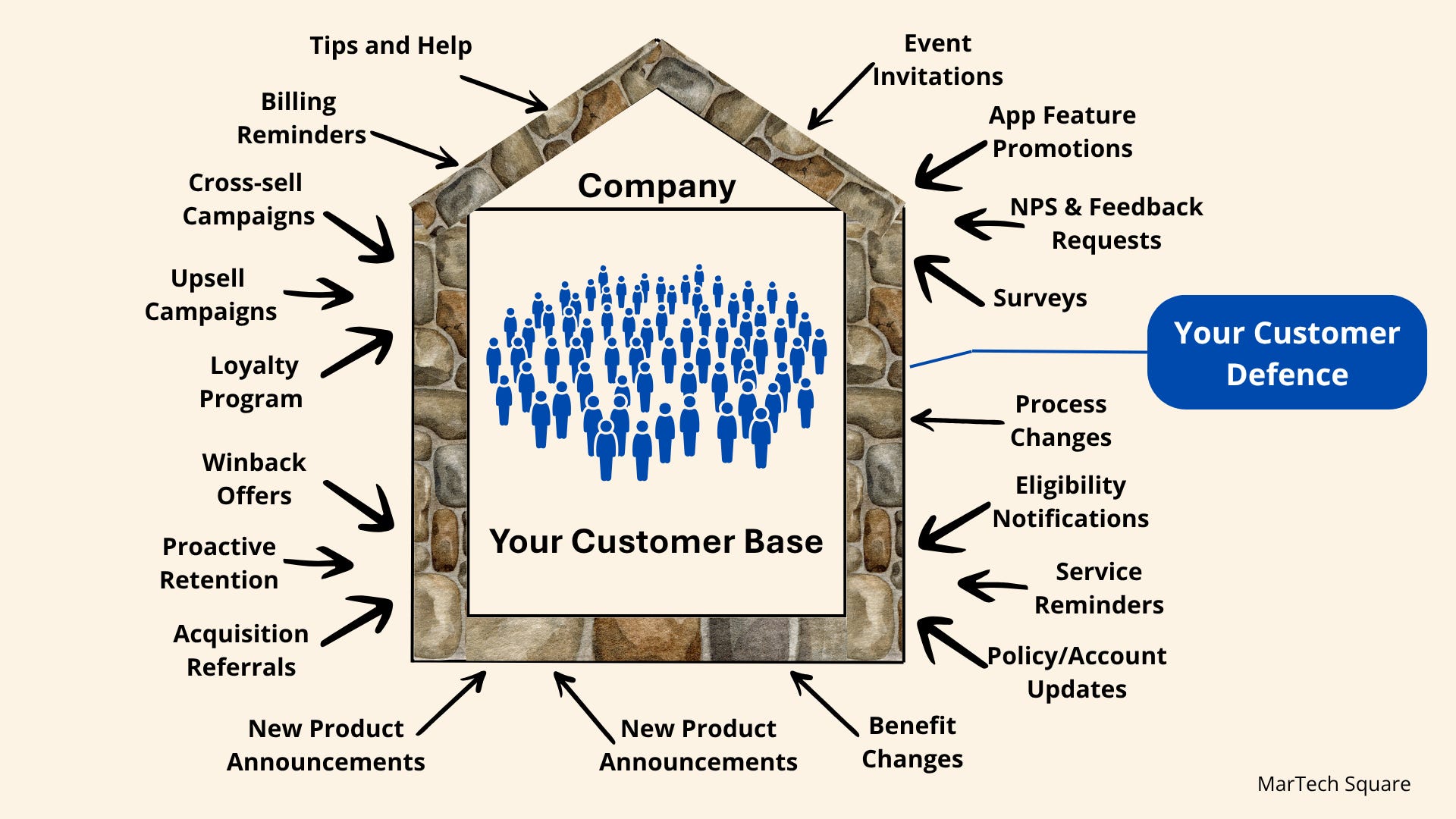
Imagine a city of 5 million residents. There are hundreds of shops, performers, billboard - each with a superpower to reach all residents of the city at their will. And they all are trying to grab their attention.
Now imagine those shops are your internal departments - Service, Loyalty, Product, Claims, Retention, Digital, Cross-Sell, Growth - all with well-meaning but siloed objectives and KPIs. Each one armed with comms calendars, campaign targets, and the pressure to “hit the numbers.”
Left unchecked to themselves, they’ll all blast messages to those 5 million customers. Every. Single. Day. CHAOS.
Not because they’re ill-intentioned but because the structure of most organisations is designed to optimise for departmental success, not end customer experience.
This is where the Customer Engagement function steps in. Not just as an orchestrator. But as the protector of your customers from internal chaos.
Your Customer Base is constantly under attack from … yourself
The Engagement Paradox
There’s an often-overlooked paradox at the heart of customer engagement: the very teams tasked with driving engagement are often the ones that must learn to limit it. Across a large organisation, each department-Loyalty, Product, Service, CX-has its own objectives and metrics to hit. Loyalty wants to push daily offers, Service is focused on driving digital adoption, Product Marketing wants to highlight new features, and CX teams are eager to collect feedback. On their own, each initiative is justifiable. But collectively, they can overwhelm the customer.
What starts as well-intentioned outreach quickly becomes noise. Inbox fatigue sets in. Notifications are ignored. Opt-outs rise. And what was meant to deepen relationships ends up eroding them. Real engagement isn’t about volume or visibility-it’s about delivering the right message, at the right moment, with the right intent. But to do that, organisations must confront one of their hardest truths: not every message deserves to be sent. And not every team can go first.
True customer engagement isn’t about frequency. It’s about relevance, timing, and context. And delivering that requires something most organisations struggle with saying no to themselves.
Customer Engagement as your Defence Layer
In most organisations, the Customer Engagement function is seen as the engine of proactive communication to the customer base. It sits at the intersection of marketing, digital, service, and product teams, tasked with creating meaningful interactions that drive action, loyalty, and long-term value. It manages campaigns, orchestrates journeys, and increasingly, personalises messaging across touchpoints. On paper, it’s the growth function. The performance engine. The one that gets customers to do things.
But that’s only half the story.
In reality, a mature Customer Engagement function doesn’t just enable communication, it curates it. It filters, sequences, prioritises. It says no more often than it says yes. And that’s not because it lacks ambition, but because it has something far more important: a mandate to protect the customer from internal chaos.
This function is your defence layer.
Customer Decisioning as a Defensive Strategy Tool
This is also where the Customer Engagement Engine- often powered by a Decisioning Layer - steps in. Not just as a delivery mechanism, but as that shining armour of your defence layer. The buffer between well-meaning departments and the customer’s patience.
Think of the Customer Engagement Engine as the central nervous system of your organisation’s communication. It sits between all your data and all your channels, constantly processing who the customer is, what matters to them in the moment, what the business hopes to achieve and how to align those elements without overwhelming the customer. It evaluates every potential message, offer, or action across departments and makes one critical decision: what delivers the most value for the customer, not just for an individual business unit. And sometimes, the most customer-centric decision it makes is to say nothing at all.
While most Decisioning conversations tend to focus on uplift, revenue, and conversion, there’s an equally powerful yet often overlooked value proposition: damage prevention.
Effective Decisioning doesn’t just drive action; it protects customers from fatigue by managing message frequency in real time, reduces unsubscribe rates by favouring relevance over repetition, and preserves trust by respecting the customer’s attention. It also prevents internal cannibalisation, where multiple departments compete for the same customer’s mindshare, and fosters cross-functional alignment by clarifying what matters most. In short, good Decisioning doesn’t just accelerate growth - it stops the organisation from eating itself.
A Little Distraction: Starfish
Under extreme stress such as sudden environmental change or lack of food, a starfish can begin to digest its own body. Scientists call this autolysis. The starfish literally breaks itself down from the inside out, using its own tissues for survival. It doesn’t look desperate at first… but soon, the damage becomes irreversible. What starts as a coping mechanism turns into self-destruction.
Not all harm comes from outside. Sometimes it’s self-inflicted. Poor Starfish.
Why This is (Politically) Hard
Here’s the uncomfortable truth: implementing a Decisioning-led Customer Engagement model challenges long-standing organisational structures. It means departments no longer have an automatic license to message customers just because they’ve budgeted for a campaign. Campaign calendars lose their veto power. Performance metrics shift from measuring volume (“How many emails did we send?”) to measuring outcomes (“Did customers act?”). And that requires more of a cultural reset than a technical one.
It also means having difficult conversations. Loyalty teams may need to find smarter ways to drive redemptions without blanket outreach. Product teams won’t get to promote every new feature on launch day. Paid media might have to admit that retargeting someone who just saw an in-app message is waste, not reinforcement. There will be pushback from middle managers whose KPIs feel threatened, from teams seeking “just this one exception.” But if your Decisioning Engine can’t say no, then it isn’t an engine - it’s just a glorified routing tool.
What This Means for CE and MarTech Leaders
If you're leading a Customer Engagement or MarTech team, this shift toward Decisioning-led engagement demands more than new tech- it requires a change in mindset, governance, and how success is defined. It starts by championing customer-centric metrics. Move away from measuring activity like send volume and focus instead on outcomes that reflect actual customer value. Redefine what "good" looks like, not by how much you pushed out, but by how much customers responded meaningfully.
This role also calls for both empathy and resolve. Understand that every team has KPIs and pressure to perform but be willing to say no when necessary. You’re not just facilitating campaigns - you’re orchestrating customer experience. That means codifying governance into both the tech stack and operating model. Don’t leave prioritisation decisions to hallway negotiations or calendar invites. Build in rules, escalation paths, and clear ownership so that trade-offs can be handled fairly and consistently.
And when those trade-offs happen, surface them transparently. If Loyalty wants to blast a million members, show the impact on CX, unsubscribes, and competing campaigns. Help executives see that Decisioning isn’t about stifling departmental success - it’s about enabling the organisation to win as a whole. That’s how you move from coordination to clarity, from noise to value.
Towards (True) Customer Centricity
The role of Customer Engagement isn’t to outshout the noise - it’s to rise above it with clarity and purpose. It’s not about how frequently we speak to customers, but whether what we say truly matters and whether it respects their limited attention.
Real customer-centricity isn’t found in faster personalisation or more campaigns. It’s found in smarter prioritisation. In making fewer, better decisions. The future of engagement belongs to those who can prioritise with precision, while personalising at speed and scale.
Request
I’d love your feedback - it only takes a minute! Tell me what you think and what you’d like to read next.