
The Customer Decisioning Vacuum
How vendors captured a discipline before brands had a chance to define it

Craft vs Crafty
In the early 2000s, “craft beer” had no definition. The Brewers Association did not publish a formal definition until 2006 - and even then, it was contested. Large breweries acquired small ones and kept the craft label. MillerCoors launched craft-positioned brands. Anheuser-Busch bought ten craft breweries between 2011 and 2017 and retained their independent branding. By 2017, a significant share of beers sold as “craft” were owned by the two largest beer conglomerates in the world. Consumers were paying craft prices for industrial products because the definition had been colonised before an independent standard existed. Among beer enthusiasts, this period came to be known as “Craft vs Crafty.”
Are we living through the same moment in customer decisioning?
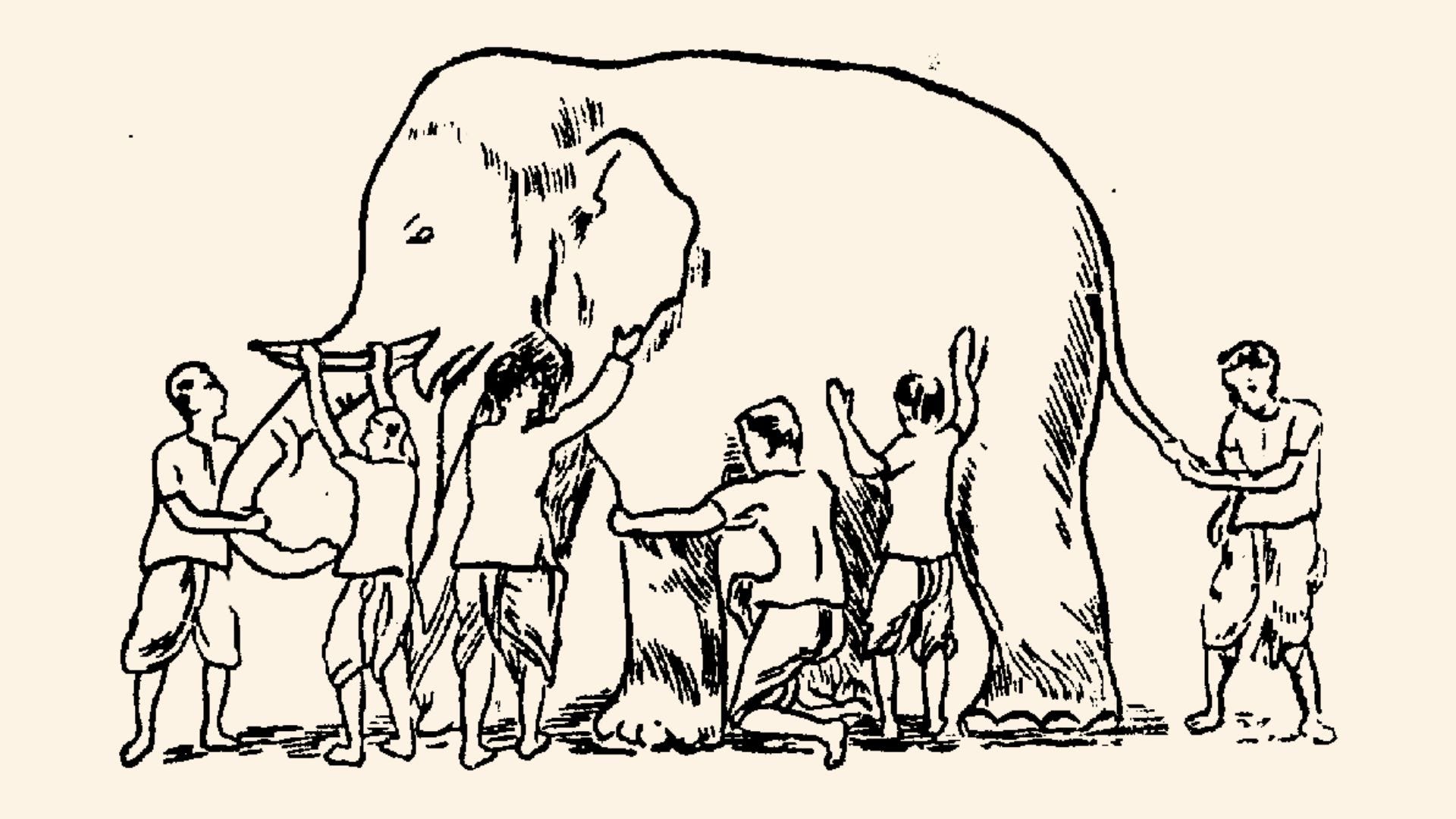
Ask ten vendors what “decisioning” means, and you get ten confident, well-marketed, entirely different answers. Ask Forrester or Gartner for a single unified category, and you find yourself navigating a maze of adjacent waves, quadrants, and market guides - each capturing a slice of the problem, none capturing the whole.
I have written on this topic before as well, though in a different context.

The result of this confusion is strategic drift. Brands are making multi-million-dollar architecture choices based on vendor narratives. And the vendors - quietly, competitively, effectively - are filling the definition vacuum with their own.
That should concern every serious practitioner in this space.
The Analyst Map: No Single Category to Orient By
If decisioning were a well-established discipline, the research firms would be the first place a practitioner would turn for clarity. They are not.
Forrester tracks Real-Time Interaction Management - RTIM -through its Wave, evaluating vendors on orchestrating personalised interactions across inbound and outbound channels in real time. Pega features prominently. But RTIM is a narrow lens. It privileges latency and channel breadth. It says little about how competing objectives get arbitrated, or how a brand governs the accumulating decisioning logic inside its systems over time.
In a separate Wave, Forrester covers AI Decisioning Platforms - focused on AI-driven automation at scale, with SAS, FICO, and others alongside Pega. Different category. Different buyers.
Gartner published its debut Magic Quadrant for Decision Intelligence Platforms in January 2026 - evaluating FICO, IBM, SAS, and others. Squarely operational in framing: supply chain, finance, risk. Not the quadrant a CMO reaches for when architecting personalisation.
So, we have: RTIM. AI Decisioning Platforms. Decision Intelligence Platforms. Customer Data Platforms. Multichannel Marketing Hubs. Customer Engagement Platforms. None maps cleanly to what serious practitioners mean when they talk about customer decisioning as the operating discipline behind customer engagement.
Seven Vendors. Seven Interpretations.
Each vendor has defined decisioning to mean whatever their strongest capability does best. This is the natural logic of category creation. It is also why the market is confused.
The profiles below are MarTech Square’s independent reading of each vendor’s publicly stated position. They are not vendor-endorsed. If I have mischaracterised your platform, I genuinely want to know.
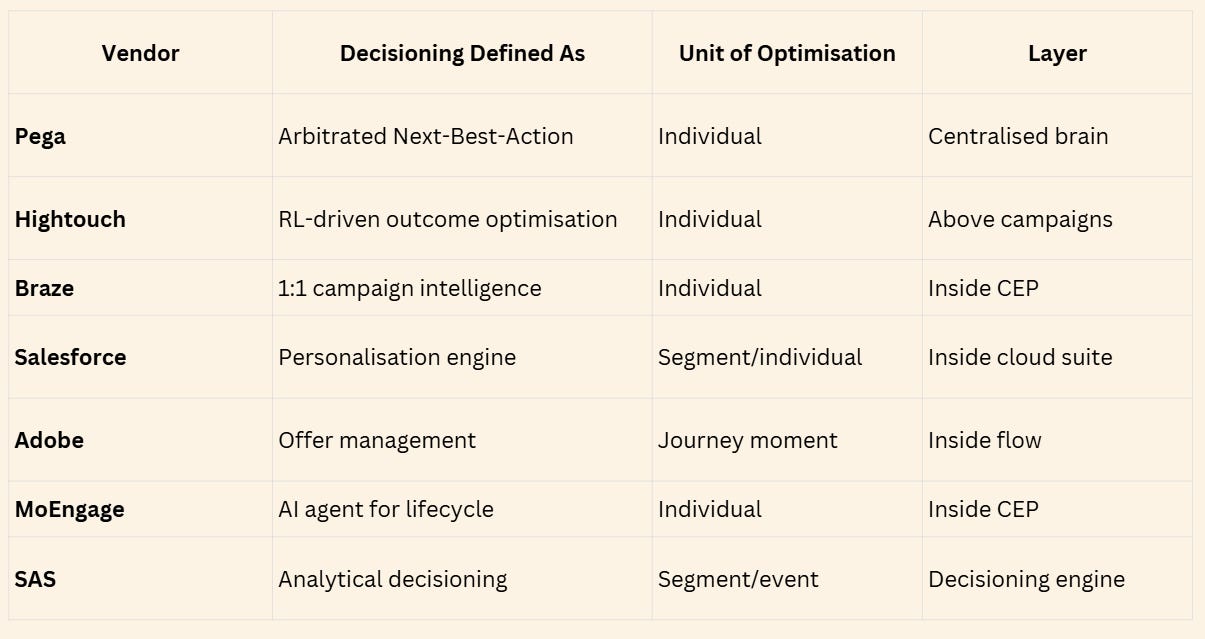
Pega: Arbitrated Next-Best-Action
Decisioning lives inside the Customer Decision Hub - an always-on brain arbitrating competing business objectives against individual customer context, using a formula that weights propensity, action value, and business levers (P×V×L) to surface a single Next Best Action. The most complete definition in the market. Also, the most demanding - centralised logic hub, cross-channel deployment, continuous AI adaptation, and significant organisational maturity. Pega's definition assumes you have the architecture to match it.
Salesforce: Personalisation Feature Within Customer 360
Einstein Decisions evaluates customer profile and behaviour to select the next-best offer from a predefined set. Decisioning is not a standalone discipline - it is a feature of Customer 360. The constraint: decisioning logic is embedded inside the suite rather than exposed as a transparent, auditable capability. A premium feature, not a foundational architecture.
Adobe: Offer Management Within the Journey
Adobe Journey Optimizer frames decisioning through Offer Decisioning - real-time offer selection integrated with Adobe’s Real-Time CDP and journey orchestration layer. The most narrowly bounded definition here. Decisioning is something that happens within a flow, not a centralised brain that governs all flows.
Hightouch: Outcome Optimisation Above the Stack
A warehouse-native layer above existing marketing channels - reading from Snowflake, Databricks, or BigQuery, using reinforcement learning to experiment across message, channel, timing, and frequency toward a defined outcome. Where Pega starts with the customer's full context, Hightouch starts with a marketing outcome and works backwards. A philosophically different premise.
MoEngage: AI Agent Inside the Engagement Platform
Merlin AI Decisioning Agent automates micro-decisions inside lifecycle marketing - product, channel, message, timing. Like Braze, embedded within the platform rather than above it. Marketer-friendly and fast to deploy but scoped to campaign execution.
Braze: Campaign Intelligence Layer
Braze entered decisioning via acquisition - buying OfferFit in 2025 and relaunching it as BrazeAI Decisioning Studio. Intelligent selection of the right channel, message, creative, offer, and timing per individual, optimised against a defined KPI. Decisioning is what replaces A/B testing at scale. The conceptual anchor remains the campaign layer.
SAS: Analytical Decisioning Engine
Decisioning as the automated application of analytical models and business rules at scale - built on decades of work in risk scoring, fraud detection, and credit decisioning. Precise, auditable, regulation ready. But conceived for operational and risk use cases, not necessarily customer engagement.
The Curious Case of Aampe: A Different Category Altogether
Most vendors define decisioning at the campaign, journey, or function level. Aampe rejects that framing entirely.
Aampe deploys one dedicated reinforcement learning agent per end-user - learning continuously, operating across all surfaces, without retraining cycles, minimum sample sizes, or marketer-defined action sets. Over 100 million agents. Between 15 and 200 billion decisions are made weekly. Those numbers alone reframe what decisioning at scale means.
Aampe’s co-founder has argued that the problem is architectural, not operational: “The methods underneath most ‘AI decisioning’ can’t do what the marketing language claims, no matter how clean the data stack is.” Organising agents by function - content, decisioning, campaigns - recreates fragmentation at the architecture level. Customers experience one brand, not separate functions. The only coherent unit of organisation, in Aampe’s view, is the individual user.
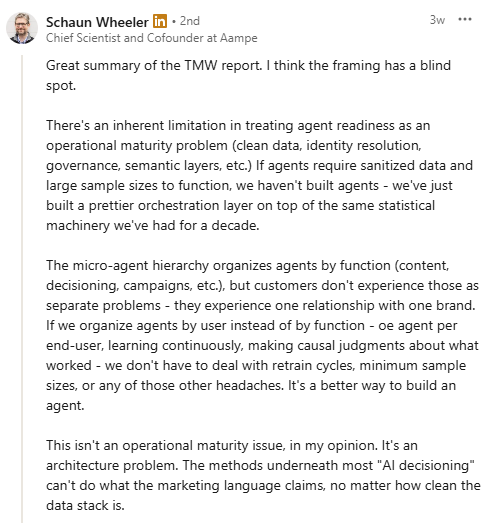
That makes Aampe’s definition the most radical here: decisioning as a continuous, causal, per-user process - without campaign boundaries, without functional silos, organised around the human rather than the business objective. No other vendor in my view fully satisfies that definition.
The Compounding Cost of Vendor-Led Definition
The problem is not that any of these definitions is wrong. Each reflects genuine capability. The problem is that when a discipline’s definition is set entirely by vendors competing for wallet share, the discipline itself gets distorted.
Four things happen as a result.
First, brands buy adjacent pieces and call them decisioning. A bank implements Pega for Next Best Action in the contact centre, Braze for lifecycle campaign optimisation, and Adobe for offer management on the website. Each vendor has sold “decisioning.” The brand has three systems with three different arbitration logics, three different data models, and no unified view of what it is actually deciding for each customer. This is not a hypothetical. It is the default state of most large financial services and telecommunications organisations today.
Second, evaluation criteria are set by the vendor with the largest marketing budget. When Hightouch publishes a guide defining AI Decisioning as reinforcement learning over a data warehouse, it is simultaneously defining the category and positioning itself as the answer. When Braze describes BrazeAI Decisioning Studio as a “decisioning layer above existing platforms,” it is designing the evaluation framework. Brands that rely on vendor-produced content to understand decisioning are being led, by definition, to vendor-preferred architectures.
Third, governance and accountability get lost. When decisioning is fragmented across vendor definitions, the question of who owns the decisioning logic becomes unanswerable. Is it the data team on the CDP? The CRM team on Pega? The digital team on Adobe? In the absence of a single owner, decisioning becomes a feature of each platform - audited by no one, governed by no one, optimised only locally.
Fourth, people become platform-certified rather than discipline-trained. A “Pega Decisioning Architect” knows how to configure the Customer Decision Hub. A “Salesforce Einstein specialist” knows how to wire up Einstein Personalization. Hard-won skills - but not decisioning expertise. The consequence surfaces the moment an organisation migrates platforms - and they always do. Intellectual capital built inside proprietary constructs has no equivalent elsewhere. It is not portable. It is stranded. Job descriptions asking for “Pega Decisioning experience” are not building a market for decisioning professionals. They are building a market for platform operators. The discipline never accumulates shared vocabulary or shared standards - because vendors have no incentive to create them.
The Moment Brands Need to Act
In June 2025, I wrote that customer decisioning is having its CDP moment the next biggest capability shifts in modern marketing. I still believe that. What has sharpened since is my view of the risk.

The definition vacuum will be filled. The only question is who fills it.
Vendors will fill it with product positioning. Analysts will fill it with adjacent categories that never quite fit. Consultancies will fill it with frameworks designed to sell transformation programmes. None of them carries the same weight as practitioners who live with the consequences of fragmented decisioning every day - who inherit stranded intellectual capital after platform migrations, who are asked to deliver personalisation at scale on architectures never designed to support it.
It is a discipline problem waiting for practitioners to claim it.
I am working toward that alongside a small group of decisioning practitioners who share this conviction. In the coming weeks, I will be sharing an initiative designed to bring senior practitioners together: to define the discipline on their own terms, build shared vocabulary, and establish the independent foundations that the vendor landscape will never create for them.
If that resonates and if you have felt the fragmentation, inherited stranded logic after a migration, or simply struggled to answer “what does decisioning actually mean in our organisation”, - I would love you to be part of this.
Requests
I’d love to hear your feedback - it only takes a minute! Let me know what you think and what topics you’d like to see next. Here is the Survey Link.
If you are a Customer Decisioning leader or practitioner - whether you work for a brand or a vendor, I’d like to talk with you about an upcoming project. Please feel free to drop me an email at pawan@martechsquare.com
Nice article, the analogy lands.
Like Darrell mentioned, this feels like déjà vu from my CDP days.
At iCustomer, we decided to position as an Agentic Decision OS composable, channel-neutral, and intentionally not tied to campaigns or CEP features but augment multiple of those.
What’s different now: buyers aren’t naive like 2015. They can tell the difference between a true decisioning layer and another “all-in-one” repackaging.
Excellent article.
"Each vendor has sold “decisioning.”" echos how the CDP landscape mutated. ("Is this ID resolution? No, this is audience definition....and orchestration")
And then layer on adtech decisioning ;)