
Gartner has a new Magic Quadrant: Decision Intelligence Platform
Reading Gartner’s first Decision Intelligence Magic Quadrant through the lens of customer decisioning, context, and real-world execution.

Last week’s deep dive into the Gartner’s CDP Magic Quadrant clearly struck a nerve. People love a good Magic Quadrant debate with their morning coffee. So, let’s keep the momentum going - this time with something a little more… intelligent.
Gartner has now published its first-ever Magic Quadrant for Decision Intelligence Platforms (DIP). It marks a significant shift: decisioning has moved from a niche idea to a recognised market category.
And frankly, it is about time. We have spent a decade chasing “data driven.” But data is just potential energy. The real value lies in decisions. Collecting data is table stakes. Deciding what to do with it is the real value.
What is Decision Intelligence Platform Magic Quadrant?
Gartner’s Decision Intelligence Platform (DIP) Magic Quadrant formalises something many organisations have done informally for years: treating decisions as engineered, operational assets rather than the accidental outcome of dashboards and meetings.
Gartner predicts that by 2030, explicitly modeled business decisions will be five times more trusted and 80% faster than ungoverned decisions.
Gartner defines Decision Intelligence platforms as software that helps organisations design, execute, monitor, and govern decisions end to end, using a combination of data, analytics, AI, rules, and human judgement. The goal is not more insight - it’s turning insight reliably into action, at scale and with accountability.
“Data and analytics leaders aren’t short of insight - they’re short of control over how insight turns into action. As AI scales, the real challenge is no longer producing better analysis, but governing, measuring, and improving the decisions that analysis feeds.”
- Rita Sallam, Distinguished VP Analyst, Chief of Research for Data and Analytics
What makes this quadrant different is its focus on the decision lifecycle: modelling, orchestration, monitoring, and governance. As AI becomes more autonomous, black-box decisions are simply unacceptable.
This is also #1 Magic Quadrant tracked by Gartner as of Januar’26 end as reported here.
Broader Industry Commentary
Whenever I am trying to make sense of anything, I listen to practitioners.
David Pidsley, also one of the authors describes the move from “data-driven” to “decision-centric.” Insight is not scarce - we are drowning in it. The constraint is execution.
Gib Bassett calls Decision Intelligence “analytics finding its operating system.” The vendor list - FICO, SAS, Pega, o9 - looks mismatched until you realise the common thread: each treats decisions as managed assets, much like code or data. Think Business Rules Management Systems (BRMS), grown up and infused with AI.
James Eselgroth adds caution: many organisations remain either intuition-led or automation-led. The real destination is augmented intelligence - human judgement and machine capability working together.
The Complication
Note: Before I move into this section, it’s only fair to acknowledge the authors of the report. They have done a stellar job legitimising Decision Intelligence as a serious enterprise capability. Frankly, only an organisation of Gartner’s stature can bring that level of credibility.
It is also worth noting that the Magic Quadrant evaluates platforms and their capabilities - not the broader ecosystem required to translate those capabilities into business value. My concern is: many organisations make long-term purchasing decisions based on these reports, and in doing so, they must look beyond the technology itself and ask questions - how will this actually deliver outcomes in our business?
Let’s discuss this.
The experts broadly agree: Decision Intelligence is the bridge between insight and outcome. The technology is genuinely impressive. But while I am fully aligned on the direction, I am less convinced that Decision Intelligence makes sense as a truly standalone, industry-agnostic platform to achieve business outcomes.
Context is the constraint.
I understand the discipline - the maths, the arbitration, the optimisation, the “if-this-then-that on steroids.” The part I question is the idea that decisioning can be cleanly abstracted from the industry it serves. Decisions don’t exist in a vacuum; they are shaped by domain realities - operational tempo, risk appetite, and regulation.
A credit decision in banking is not the same as a next-best-action decision in customer engagement, and neither resembles a supply chain allocation or a healthcare triage decision. The mechanics may overlap, but the implications absolutely do not.
This is why, as useful as the Magic Quadrant is, organisations need to look at the vendor mix with a critical eye. You have o9 Solutions (supply chain planning), FICO (credit risk), and Pegasystems (CRM and engagement). Yes, they are all “making decisions” in a technical sense - ingesting data, applying logic, and producing an action. But asking a supply chain platform to manage customer empathy, or a credit risk engine to manage real-time inventory allocation, is a recipe for disaster.
Case in Point: Pegasystems’ Two Brains
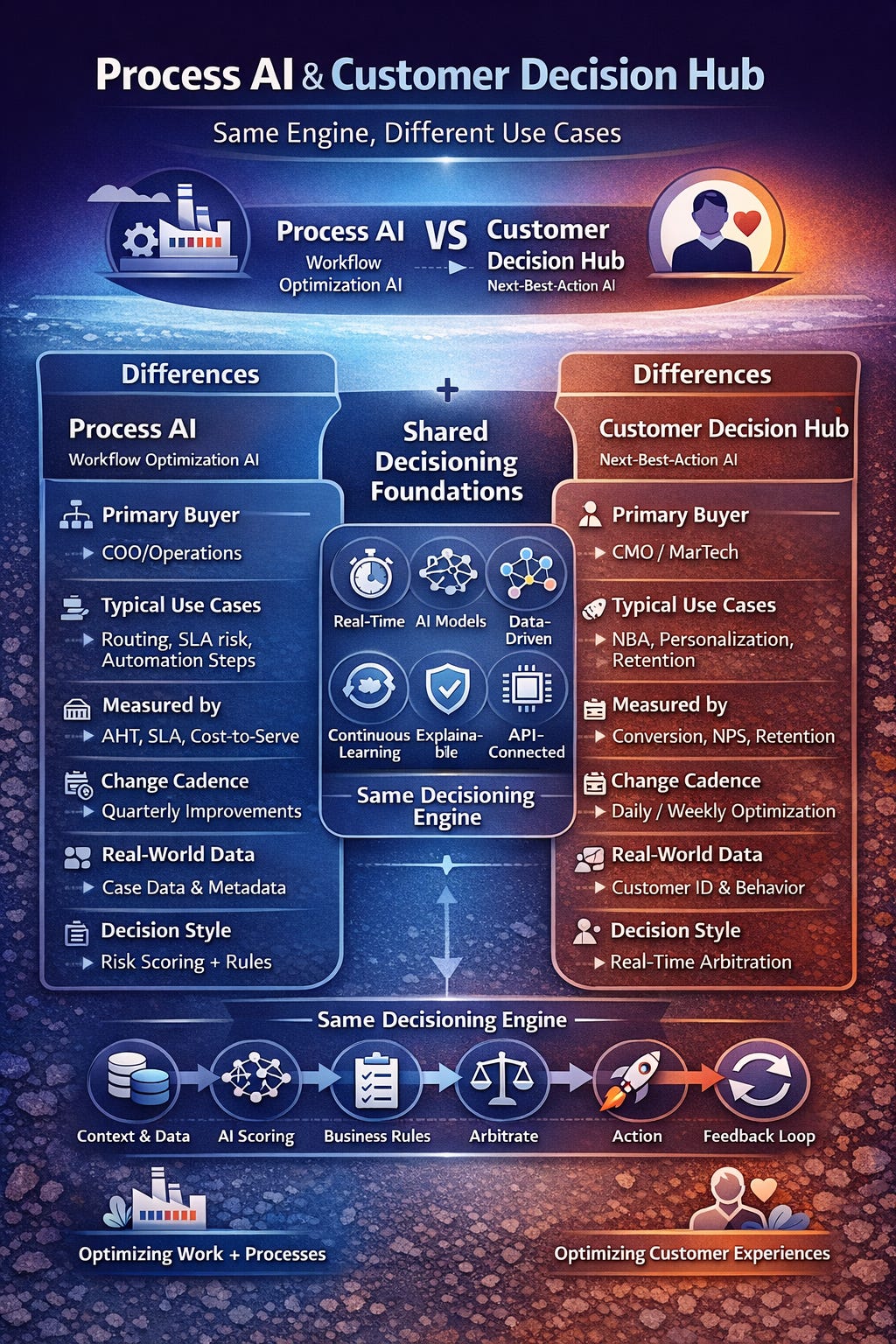
Pegasystems, positioned as a Challenger in the report, offers a useful illustration of this tension. Inside Pega, you effectively have two major capabilities built on the same underlying technology.
Process AI serves operations. It optimises workflows, routes claims, automates back-office tasks, and predicts case outcomes. It’s inward-facing - deciding whether a claim should be auto-approved or escalated.
Customer Decision Hub (CDH) serves business and marketing. It powers Next-Best-Action - deciding what to say or offer to a customer in the moment.
The core technology is largely identical: the same models, the same learning loops, the same strategy framework. Yet the operational reality is completely different.
Sell Process AI to a CMO and you’ll get blank stares. Sell CDH to a COO and it sounds like marketing fluff. Same brain. Different problems
My argument is that Decision Intelligence may be a valid horizontal category for Technology, but successful adoption is always vertical and domain specific.
A Personal Experience
A few years back, I was interviewed to help lead a Pega Customer Decisioning practice at a mid-sized consultancy. The co-founder and CTO told me confidently: “Pega Customer Decision Hub and Process AI are essentially the same thing. The market is just confused by the labels.”
I tried to explain that while the underlying decisioning technology may be similar, the two are designed for fundamentally different purposes. They have different buyer personas, different ways of working, different governance expectations, and ultimately very different operating models. One is primarily technology-led; the other is business-led. They demand different skills, different mindsets, and different problem-solving approaches.
I don’t think that the distinction was appreciated. Even though, I got the role, I respectfully declined it. It was the right decision.
The Locked-In Genius
In the mid-19th century, the telegraph was hailed as the “nervous system” of commerce. For the first time, information moved faster than a galloping horse. But businesses didn’t immediately get better. Managers had the “intelligence- they knew prices in London while sitting in New York, but their warehouses were still managed by hand, their ships moved by unpredictable winds, and their local clerks had no authority to act on the news.
The “brain” was firing, but the “body” of the enterprise was lagging by weeks.
Fast forward today, and we invest millions into sophisticated AI models and “brains” that can predict churn with 99% accuracy. Yet, if that intelligence is trapped in a paralysed corporate body - unable to ingest data in real-time or activate across channels, it is just an expensive academic exercise.
I think of Decision Intelligence as the brain of the organisation. It can reason, predict, and recommend. But a brain without a functioning body is tragic. You can build the smartest models imaginable, yet if your data arrives three days late, or your processes still require three approvals and a spreadsheet, the intelligence simply has nowhere to go.
It sits there, impressive and useless, like a Formula 1 engine installed in a shopping trolley.

The Blueprint for Connection
Regular readers know where my loyalty lies. I have always been drawn to the customer domain - not just as a market, but as a discipline. To me, a decision is not just about abstract optimisation or efficiency; it is about empathy, timing, and relevance.
And this is where we need to draw a line.
Gartner’s Decision Intelligence framing is fantastic because it finally legitimises the engine - the operating system sitting between data and execution. But while Gartner describes Decision Intelligence as a horizontal, enterprise-wide capability, Customer Decisioning is a domain-specific instantiation of those same principles.
In this domain, a familiar pattern repeats itself. Organisations invest heavily in “decisioning engines” and expect transformation to follow automatically, only to discover that fragmented data, brittle integrations, and manual workflows quietly neutralize all that sophistication. The result is a brilliant brain connected to a paralysed body - technically correct, strategically ineffective.
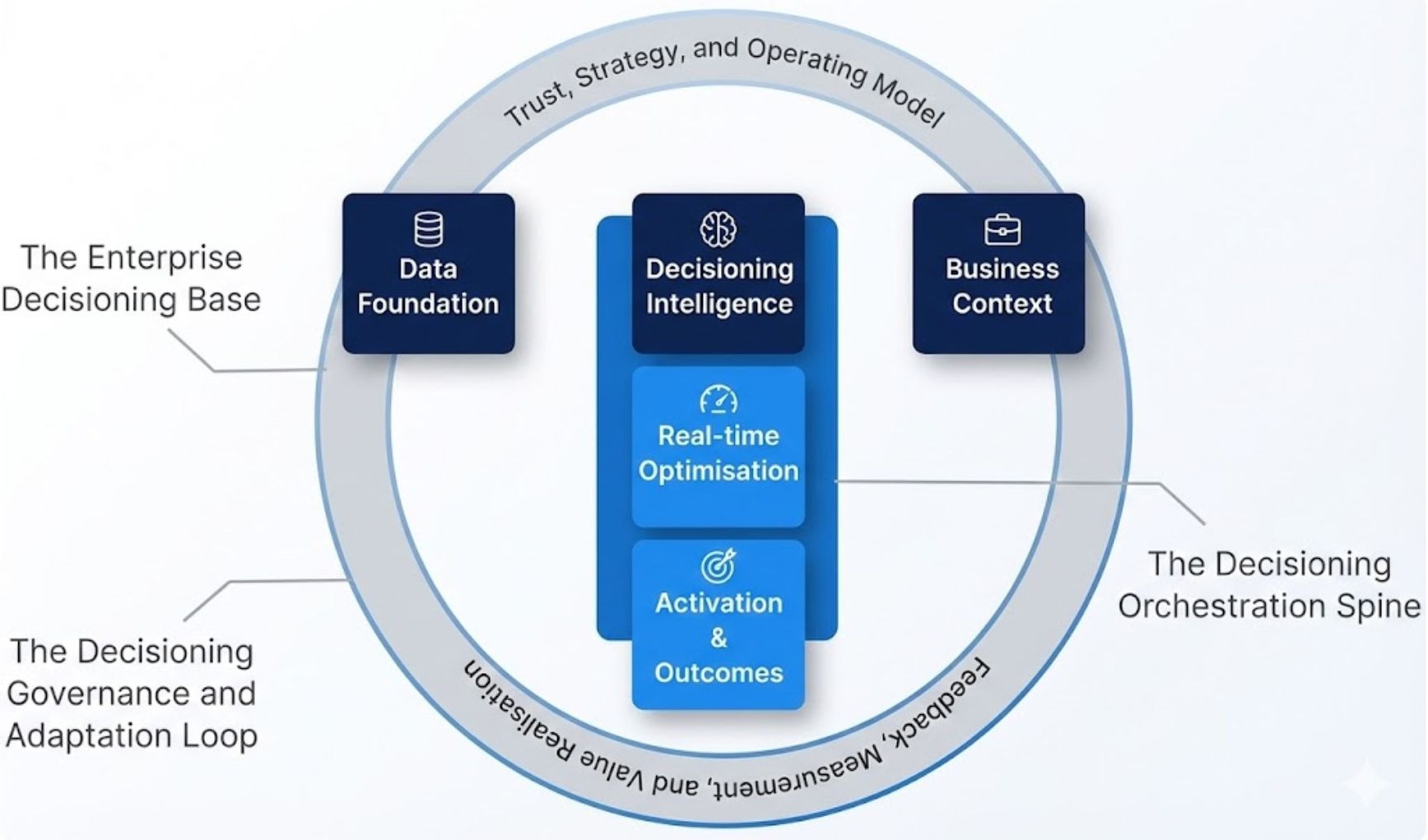
This is precisely why, in the Customer Decisioning Blueprint, Decision Intelligence sits at the centre but not stands alone.
To work, it must be bookended by reality:
Upstream: It needs a robust data foundation and clear business context.
Downstream: It needs real-time orchestration and activation channels that can actually do what the brain commands.
Surrounding it: The less glamorous - but arguably more important - machinery of trust, governance, and operating models.
The Real Question Organisations Should Be Asking
When we look at Gartner’s Decision Intelligence Magic Quadrant, we should not see a vendor shortlist. We must ask a harder question: “do we understand our decisions well enough to choose the right decisioning paradigm at all?”
Because adopting a platform without clarity on which decisions matter, who owns them, how fast they must run, and what failure looks like is just a more expensive version of being “data driven.” The tooling improves. The outcomes rarely do.
That said, this Magic Quadrant matters. It legitimises decisioning as a first-class discipline and shifts the conversation from “what data do we have?” to “what decisions are we automating, and why?” At a time when AI is becoming increasingly autonomous, that language of governance, explainability, and accountability couldn’t be more necessary.
For the C-suite: before investing in another “intelligent” engine, focus on your data foundation and activation. Don’t build a genius brain for a paralysed body. Make sure your organisation can actually act on the decisions it makes.
Requests
I’d love to hear your feedback - it only takes a minute! Let me know what you think and what topics you’d like to see next. Here is the Survey Link.
If you are a Customer Decisioning leader or practitioner - whether you work for a brand or a vendor, I’d like to talk with you about an upcoming project. Please feel free to drop me an email at pawan[@]martechsquare.com
This article is amazing, I love your Decisioning Intelligence framework!