
Decisioning Debt: The Structural Cost of Fragmented Customer Judgment
How Fragmented Customer Logic Is Eroding Experience, Trust, and ROI

Sarah, David and Priya
Sarah, a frequent flyer, had just spent six hours navigating a cancelled flight. The airline had rebooked her, issued a hotel voucher, arranged a shuttle. At 11:30pm, waiting in the lobby, her phone buzzed: “Plan your next getaway. Earn double points.” The offer wasn’t wrong. Sarah was exactly the customer it was designed for. The airline just didn’t know she was currently in one of its airport hotels, involuntarily.
David had spent three months refinancing his mortgage. Documents submitted, calls with a relationship manager, signed digitally. The day after his new rate was confirmed, he received a letter - physical mail, addressed to him by name - from the same bank, offering a mortgage consultation to “explore whether you could be saving on your home loan.” The propensity model had correctly identified him as a high-value prospect. It just didn’t know he’d already refinanced. Yesterday.
Priya had just had her knee replaced. Her private health insurer had approved the procedure, processed the claim, and reimbursed the hospital. Three days later, she received a marketing email from the same insurer: “Protect Your Knees Before It’s Too Late.” The claim system knew. The marketing system didn’t - and the email went to thousands of customers as part of a scheduled campaign. No one had taken responsibility for the decision that sat between them.
None of these stories are unusual. You have probably lived a version of at least one of them. The retargeted ad for the laptop you already bought. The promotional offer from a brand you just complained to. The renewal reminder for a policy you upgraded last week. Each one is a small moment of friction. Collectively, they represent something far more costly - to the customer relationship, and to the organisation generating them. This is Decisioning Debt.
What Is Decisioning Debt?
In software engineering, technical debt describes the future cost of shortcuts taken today - code that works but was written hastily, systems bolted together rather than integrated. They function in the short term and compound into slow, expensive liabilities over time.
Decisioning Debt is the same principle applied to customer engagement. It is the accumulated cost of fragmented, siloed, or absent decisioning capability - the gap between what a brand knows about a customer and what it does with that knowledge at the moment of interaction.
It manifests in four forms:
Fragmented decisioning: multiple systems making conflicting decisions about the same customer simultaneously
Context blindness: offers and messages triggered by segment rules rather than situational signals
Temporal decay: acting on stale data - decisions based on who the customer was, not who they are
Channel amnesia: a customer resolves something on the app, then hears nothing about it from the contact centre an hour later
The reason this debt is dangerous isn’t just poor experience. Organisations are paying interest on it every day - in churn, wasted spend, compliance risk, and the slow erosion of brand trust - without ever seeing a line item that reads “Decisioning Debt: $242 million.”
The Price Tag Is Not Hypothetical
According to Qualtrics’ 2024 research, bad customer experiences now put $3.8 trillion in global sales at risk annually. More than half of consumers say they will cut spending after a single bad experience.
Southwest Airlines' Christmas 2022 collapse - 16,900 cancelled flights, two million stranded passengers - was not caused by weather. It was a scheduling and decisioning system dating to the 1990s that could not integrate real-time data. Managers fell back on spreadsheets and phone calls. Total cost: $1.1 billion in refunds and lost revenue, plus a $140 million federal penalty. Decisioning debt collected at scale.
In Telecoms, annual customer churn rates range from 20% to 50%. For a provider with one million customers at $50 monthly ARPU, 20% churn is $120 million in lost revenue annually. Yet only 5% of telecom providers fully leverage data-driven personalisation, despite 80% of consumers saying they're more likely to stay with organisations that tailor their experience. McKinsey’s telecoms outlook confirms the root cause - telcos urgently need to standardise fragmented systems, break down silos, and make data accessible at all levels. Not a future aspiration - a description of an existing failure.
In Financial Services, 39% of banking customers who switched providers in 2024 cited poor customer service as the primary reason. Not bad products. Systems that didn't talk to each other, agents without context, follow-up that never came. The product was fine. The decisioning around it was broken.
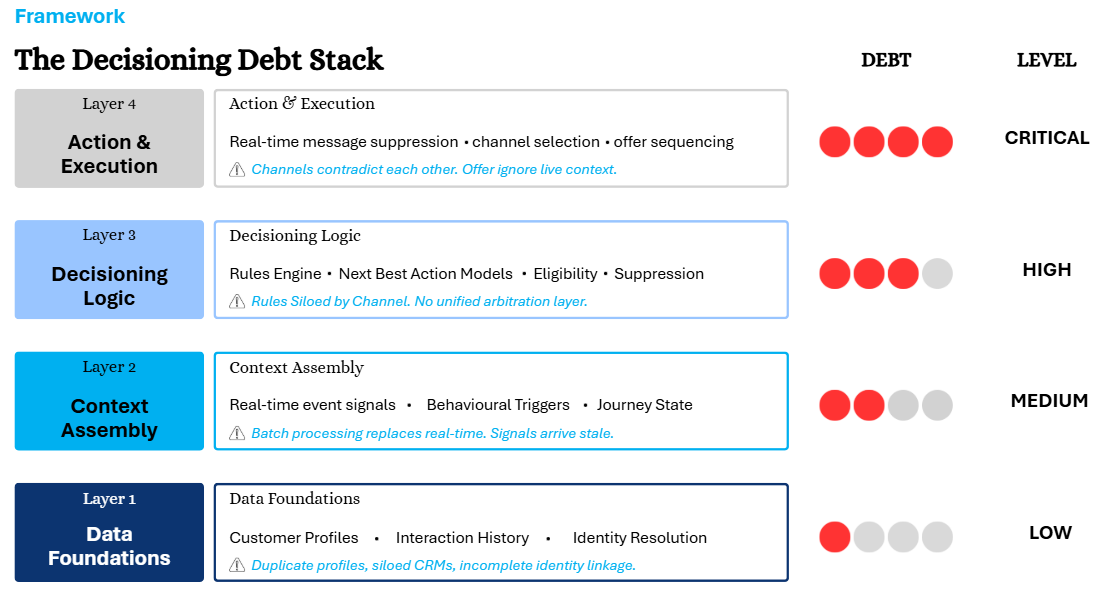
The Decisioning Debt Stack
Think of decisioning debt as accruing across four layers of an organisation’s capability - from data to action. Most organisations are strong in data collection and weak in real-time, contextual execution. The gap between those layers is where the debt lives.
The Three Symptoms Nobody Measures
The Wrong Next Best Action
A customer who just lodged a complaint receives a promotional upsell email two hours later. The complaints system and the marketing platform operate independently. The email sees a high-value segment and fires. No one fixes the architecture. The marketing team optimises the subject line instead.
The Repetition Loop
Customers repeatedly provide the same information across touchpoints. Each channel makes a fresh, uninformed decision rather than a contextually enriched one. The customer experiences this as being invisible.
The Timing Mismatch
A retention offer arrives three days after the customer ported their number. The data was there. The customer was in the model. The decisioning velocity was too slow. McKinsey research shows that AI-powered lifecycle engagement can drive 5–8% revenue improvement and 30% churn reduction when decisioning is truly integrated. When it isn't, the same data sits in a report nobody reads in time to act.
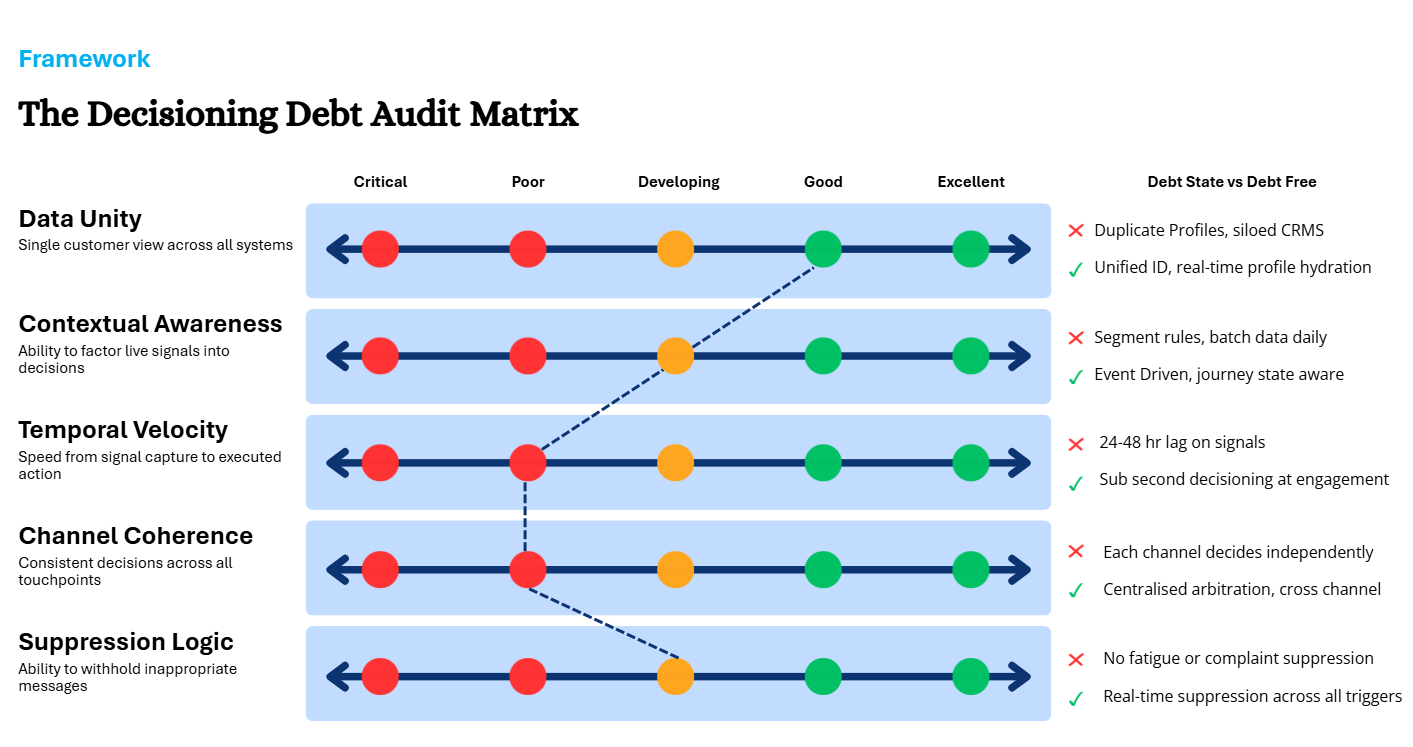
The Decisioning Debt Audit Matrix
The most useful thing a senior MarTech or CX leader can do right now is to map their organisation against five dimensions of decisioning health: Data Unity, Contextual Awareness, Temporal Velocity, Channel Coherence, and Suppression Logic. Rating each dimension on a 1–5 scale reveals where debt has accumulated and where the highest-interest payments are being made.
How It Kills Customer Experience: The Compounding Effect
PwC research shows 32% of customers will walk away after a single bad experience and it takes up to 12 positive experiences to offset one negative one. For organisations with unresolved decisioning debt, negative experiences aren't edge cases. They are structurally embedded in the journey.
The sequence is predictable. The customer becomes less responsive to marketing. Then reduces their product usage. Then the next time a competitor appears with a contextually relevant offer - the one the incumbent should have made three months ago - they leave. The decisioning debt didn’t cause a single event. It eroded a relationship, slowly and invisibly, until the competitor’s acquisition was trivially easy.
This is the cost that doesn’t appear in dashboards: the customer lifetime value that silently left the building.
Companies that prioritise customer experience have 1.6 times the customer lifetime value of those that do not. Brands that deliver poor experiences don't just lose direct revenue - they lose the 72% of customers who share a positive experience with six or more people and gain the 13% who will tell 15 or more people about a negative one.
Why AI Accelerates the Problem
AI increases decision throughput.
Without orchestration:
More models = more optimisation conflicts
More real-time triggers = more fatigue exposure
More experimentation = more inconsistent treatments
Automation without governance scales incoherence.
The Root Causes
Decisioning debt accumulates from three structural forces.
Organisational silos produce separate data ownership, separate KPIs, and separate technology stacks across marketing, service, sales, and digital. Each team makes locally rational decisions that are globally incoherent. The bank’s marketing team had no visibility into David’s refinancing approval.
MAP-first thinking - building engagement around Marketing Automation Platform capabilities — results in campaign-centric, batch-and-blast architectures fundamentally misaligned with real-time, contextual decisioning. MAPs were designed for outbound campaigns, not two-way, event-driven judgment.
Vanity metric governance means teams are measured on open rates, CTRs, and leads generated - not decisioning quality, suppression accuracy, or contextual relevance. When you measure outputs rather than decisions, you optimise for the wrong thing. Bad metrics accumulate debt.
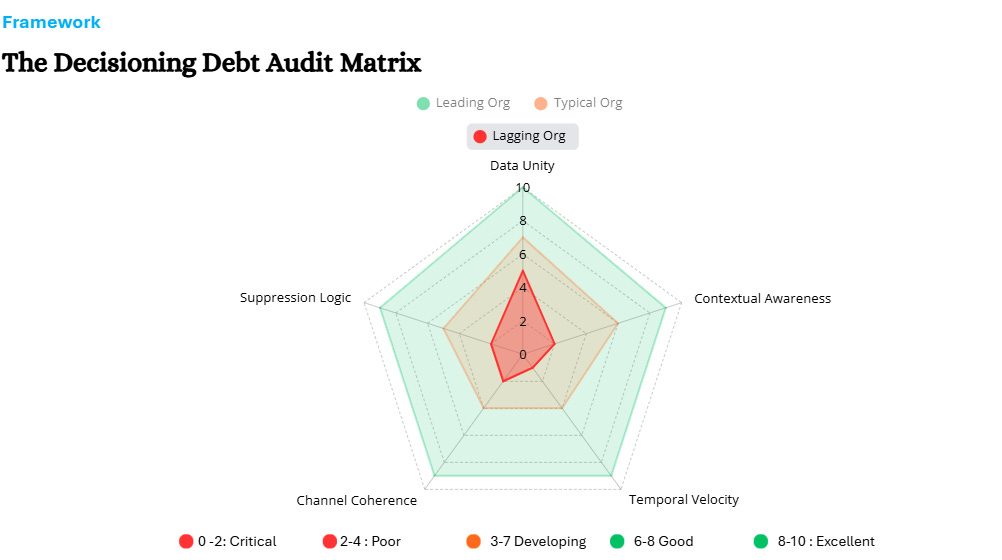
The Decisioning Health Scorecard
See companion visual: A five-dimension radar/spider chart mapping decisioning health across Data Unity, Contextual Awareness, Velocity, Channel Coherence, and Suppression Logic.
Audit Before You Build
The temptation when confronting decisioning debt is to reach for a new platform. Sometimes that is the right answer. More often, it is the wrong answer applied to a correctly diagnosed problem.
Before any technology decision, do the audit. Map your current decision points across the customer journey. For each: who owns the decision? What data does it consume? How fast does a signal travel from capture to action? Where do systems contradict each other?
What you will find, almost invariably, is not a technology gap. It is a decisioning architecture gap. The technology to fix it often already exists in your stack. What’s missing is the connective logic, the governance model, and the shared framework that turns siloed tools into a coherent brain.
PwC’s research shows that CX-focused companies can command a price premium of up to 16% on their products and services. The upside of resolving decisioning debt is not just cost avoidance, it is also competitive differentiation, compounded.
Don’t think that you don’t have a Decisioning Debt. You Do. Every organisation that has grown, merged, retooled, or scaled without a unified decisioning architecture does. The question is: how long will you keep paying the interest?
Customer Decisioning at MarTech World Forum, Melbourne
I will also be speaking at the MarTech World Forum in Melbourne on 17 March, where I will be presenting a session titled “Customer Decisioning: A Practical Blueprint for Modern MarTech.”
If you are attending the forum, I would love to meet you and continue the conversation in person.

Requests
I’d love to hear your feedback - it only takes a minute! Let me know what you think and what topics you’d like to see next. Here is the Survey Link.
If you are a Customer Decisioning leader or practitioner - whether you work for a brand or a vendor, I’d like to talk with you about an upcoming project. Please feel free to drop me an email at pawan@martechsquare.com
Excellent audit framework. One addition to Data Unity: even unified data warehouses fail at decisioning if they can't resolve the same customer across systems. The marketing platform sees 'Sarah Smith' from the web, complaints has 'S. Smith' from mobile, loyalty knows 'Sarah J Smith.' Three records, one person, contradictory decisions.
When the complaints system and marketing platform each have their own version of 'Sarah,' even perfect decisioning logic fails. You can't suppress an offer to someone who just complained if you don't know it's the same person. Entity resolution isn't just about clean data—it's the prerequisite for everything else in your decisioning stack. Without it, you're orchestrating decisions across phantom duplicates.
Enjoyable read. Really like your framing on Decision Debt. Most would consider it a form of technical implementation debt (e.g, siloed, disconnected biz rules, event triggers, etc). But what you’ve highlighted is that it really is a different form of debt. Its implementation with a lack of an enterprise-specific world model and boundaries on decision authority.