
Conway's Law: Why Your MarTech Stack Looks Like Your Org Chart
A 1968 observation about software teams explains why your Multi-Million Dollar MarTech stack still can't agree on who the customer is.

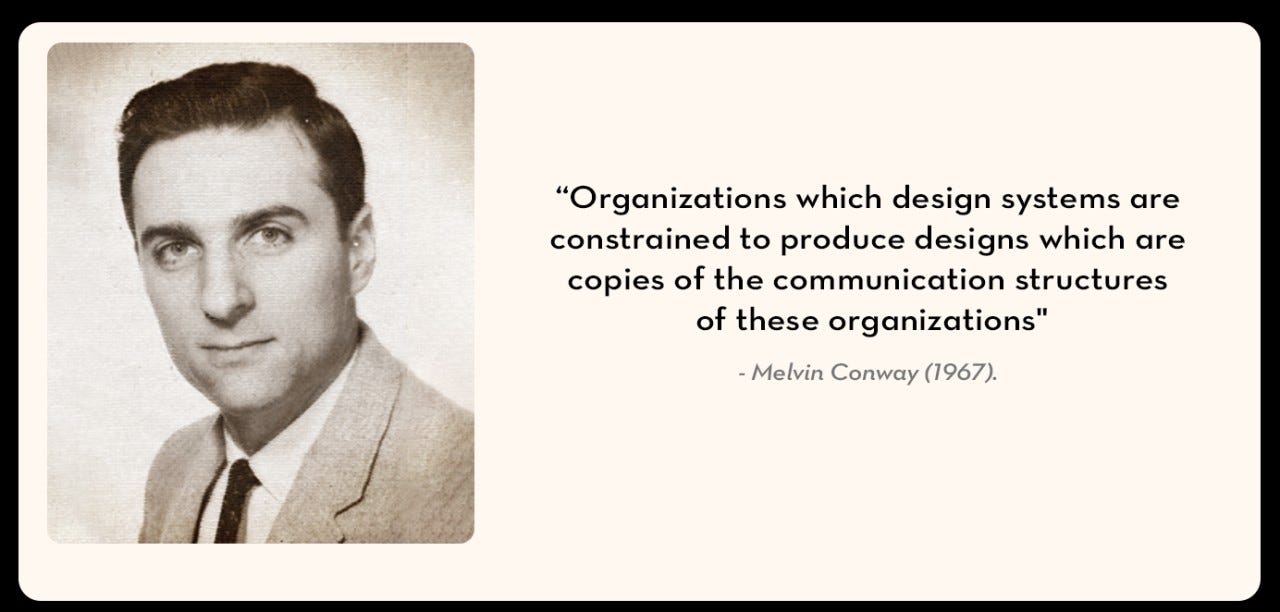
In April 1968, a computer scientist named Melvin Conway published a short paper in Datamation magazine with an unassuming title: “How Do Committees Invent?” Harvard Business Review had rejected it the year before for lacking proof. The thesis Conway proposed was deceptively simple. Organizations which design systems are constrained to produce designs which are copies of the communication structures of these organizations. Fred Brooks picked it up in The Mythical Man-Month and gave it a name. Conway’s Law has been quietly explaining failure modes in technology ever since.
The classical example is a compiler team. Four engineers will build a four-pass compiler. Three teams that don’t talk to one another will produce a website with three navigation menus that don’t reconcile - a Shop tab, a Learn tab, a Support tab, each mirroring a department rather than a customer need. The system is shaped like the org chart. Always.
Most enterprise architects accept this when discussing core systems. Senior marketing leaders also recognise it intuitively - anyone running MarTech in a large organisation has watched the email team, the paid media team, the loyalty team, and the digital team each defend their own platform, their own data model, and their own definition of the customer. The fragmentation is not hidden. It is named in every stack rationalisation deck, every CDP business case, every “single view of customer” initiative of the past decade.
What gets omitted is not the observation but the implication. Conway’s Law, properly understood, says you cannot solve this with technology. The CDP will not unify a fragmented organisation. The CEP will not orchestrate teams with separate P&Ls. The decisioning engine will not arbitrate between leaders measured on incompatible KPIs. Every one of those platforms will faithfully inherit the boundaries that already exist and re-express them in software.
Why the large enterprise is the purest case
MarTech procurement in most enterprises is decentralised by design. The CMO controls the brand and email budget. The Chief Digital Officer controls the web and app stack. The Chief Data Officer controls the data platform. The Chief Customer Officer, where one exists, controls loyalty and service. Four leaders, four budgets, four vendor relationships, four roadmaps. The stack did not fragment by accident - it fragmented because the operating model required it to.
Each leader optimises for the part of the customer experience they are accountable for. Each procurement decision is rational at the level of the individual function. The collective output is a stack that cannot answer a single coherent question about the customer, because no single leader was ever empowered to ask one.
The shape of the MarTech stack is the shape of the org
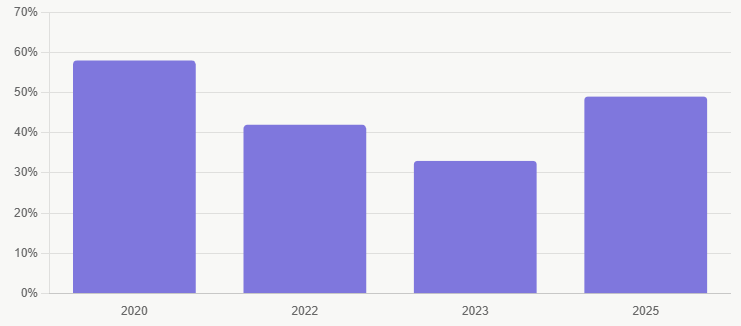
Consider what has happened to enterprise marketing technology in fifteen years. Scott Brinker's MarTech Landscape catalogued over 15,000+ tools in 2026, with a compound annual growth rate of 34.5% over fifteen years — a 100X growth. Chiefmartec found enterprise businesses use an average of 120 marketing tools. Yet Gartner's survey of 405 marketing leaders found utilisation of the overall martech stack dropped to 33% in 2023, down from 42% in 2022 and 58% in 2020.
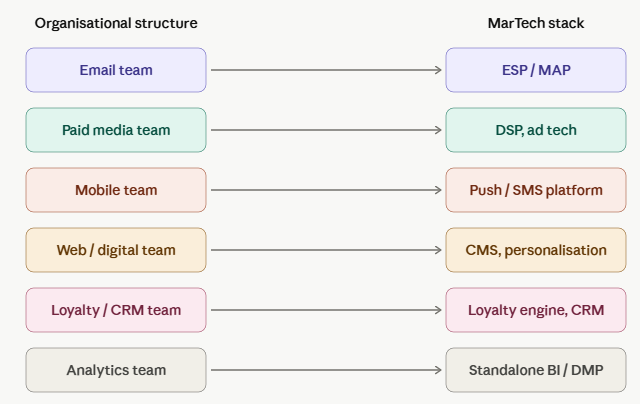
The conventional explanation blames vendor proliferation, weak governance, or insufficient talent. These are symptoms, not causes. Marketing organisations grew up in channels - email, social, paid media, content, web, CRM, loyalty. Each team bought the tool that solved its channel-specific problem. Each tool carried its own data model, its own audience definition, its own measurement logic. The stack mirrors the organisational chart because the people designing the stack are the organisational chart.
A company with separate paid media, organic social, and lifecycle email teams will, with near certainty, produce a stack with a DSP, a social management platform, and an ESP that share no common audience definition. The website's "What does this customer look like?" question gets three different answers depending on which system you ask. The customer experiences the consequence as inconsistency. The marketing leader experiences it as overlapping martech solutions, difficulty recruiting talent to drive adoption, and the complexity of the ecosystem.
The mirror principle in practice
Take the question of customer data. The CDP was conceived as the solution to fragmentation - a unifying layer above the channel chaos. In practice, CDP implementations frequently reproduce the problem they were meant to solve. Tealium's own consultants describe the failure pattern bluntly: there's a CDP champion who sits on one team, but it takes more than one team to facilitate the change management required for the implementation. If they can't tap into team members across the organisation against those rigid silos, it causes problems. The CDP becomes, in Amperity's own phrasing, yet another silo in the workplace.
A unified data platform implemented by a fragmented organisation produces a fragmented data platform. The technology cannot route around the communication structure that created it. Channel owners optimise for channel KPIs like email open rate or push CTR rather than customer-level outcomes like CLV, creating internal competition instead of coordination. Attribution models differ by channel, so no one agrees on what drove the conversion, and budget allocation becomes political. The CDP sits in the middle of this, faithfully reflecting the disagreement back at every team that queries it. Insider captures this in 10 Omnichannel marketing challenges and how to solve them in 2026.
Why Customer Decisioning suffers most
If Conway’s Law explains the shape of customer data, it explains decisioning even more decisively. A decisioning engine - the brain that determines what message, offer, or experience each customer should receive at each moment - is only as good as the upstream agreement about who the customer is and what success looks like.
Most enterprises do not have that agreement. The email team optimises for open rates. Paid media optimises for ROAS. Web optimises for conversion rate. Loyalty optimises for points redemption. Each has its own dashboard, its own attribution window, its own definition of a “win.” Asked to centralise decisioning, the resulting engine inherits all these definitions simultaneously and reconciles none of them. It becomes a router of channel-specific tactics rather than an orchestrator of customer experience. The architecture is downstream of the conversation, and the conversation is fractured across four executives who each have a legitimate claim to a part of the customer.
The inverse manoeuvre
Conway’s Law has a corollary that practitioners in software architecture began naming around 2015: the Inverse Conway Manoeuvre. James Lewis at Thoughtworks, later codified by Matthew Skelton and Manuel Pais in Team Topologies, proposed turning the law upside down. Rather than expecting teams to follow a mandated architecture design, organise team structures to match the architecture you want the system to exhibit.
Amazon’s two-pizza teams are the canonical example. The architecture wanted - microservices with stable contracts between them - could not be drawn into existence by an architect. It had to be grown by giving each team end-to-end ownership of a service and forbidding direct cross-team data access. The result was an architecture that emerged from team structure rather than fighting it.
The implication for MarTech is significant. If you want an integrated customer experience, you cannot buy your way to it through a CDP, a CEP, or a decisioning engine. The architecture you actually want - unified customer identity, shared audience definitions, centralised orchestration, channel-agnostic measurement - will only emerge if the underlying team structure rewards it. Teams organised around customer outcomes, with shared P&L for customer lifetime value, tend to produce stacks that converge naturally, because no one in the meeting is defending their tool’s territorial claim.
What the data is actually telling us
Look back at the utilisation chart with this frame in mind. The decline from 58% to 33% between 2020 and 2023 was not, as Gartner sometimes implies a problem of skills or governance. The pandemic acceleration added tools faster than the organisation could absorb them, and each new tool arrived at the boundary of an existing team. The team gained capability; the stack gained surface area; the organisation gained no new connective tissue. Utilisation collapsed because Conway’s Law was working perfectly.
The partial recovery to 49% in 2025 tracks the period in which leading marketing organisations began restructuring around customer journeys rather than channels. Some of the recovery is consolidation pressure. Some is AI absorbing tasks that previously required dedicated tools. But the most durable component is structural: the teams reporting the highest utilisation are the ones that have organised themselves around shared customer outcomes. Their stack reflects that, because it cannot do otherwise.
A question for the next budget cycle
The question most marketing leaders ask their MarTech teams is “what should we buy?” or, when budgets tighten, “what should we rationalise?” Conway’s Law suggests these are the wrong questions, or at least secondary ones. The prior question is harder and more political: who in this organisation has the authority to overrule a channel leader in favour of a customer-level outcome, and is that authority real or only declared?
If the email team and the paid media team report to different VPs, with different incentive plans, no platform - no matter how expensive - will integrate their work. The architecture has already been written by the org chart. Procurement will only ratify it.
Enterprise architecture is reflective of the operating model. The harder version of that observation, the one Conway was actually making, is that the operating model is destiny. You cannot draw your way out of an organisational shape; you can only restructure it. MarTech leaders who keep treating their stack as a tooling problem will keep buying their organisational chart back from vendors, one logo at a time, and wondering why utilisation slides.